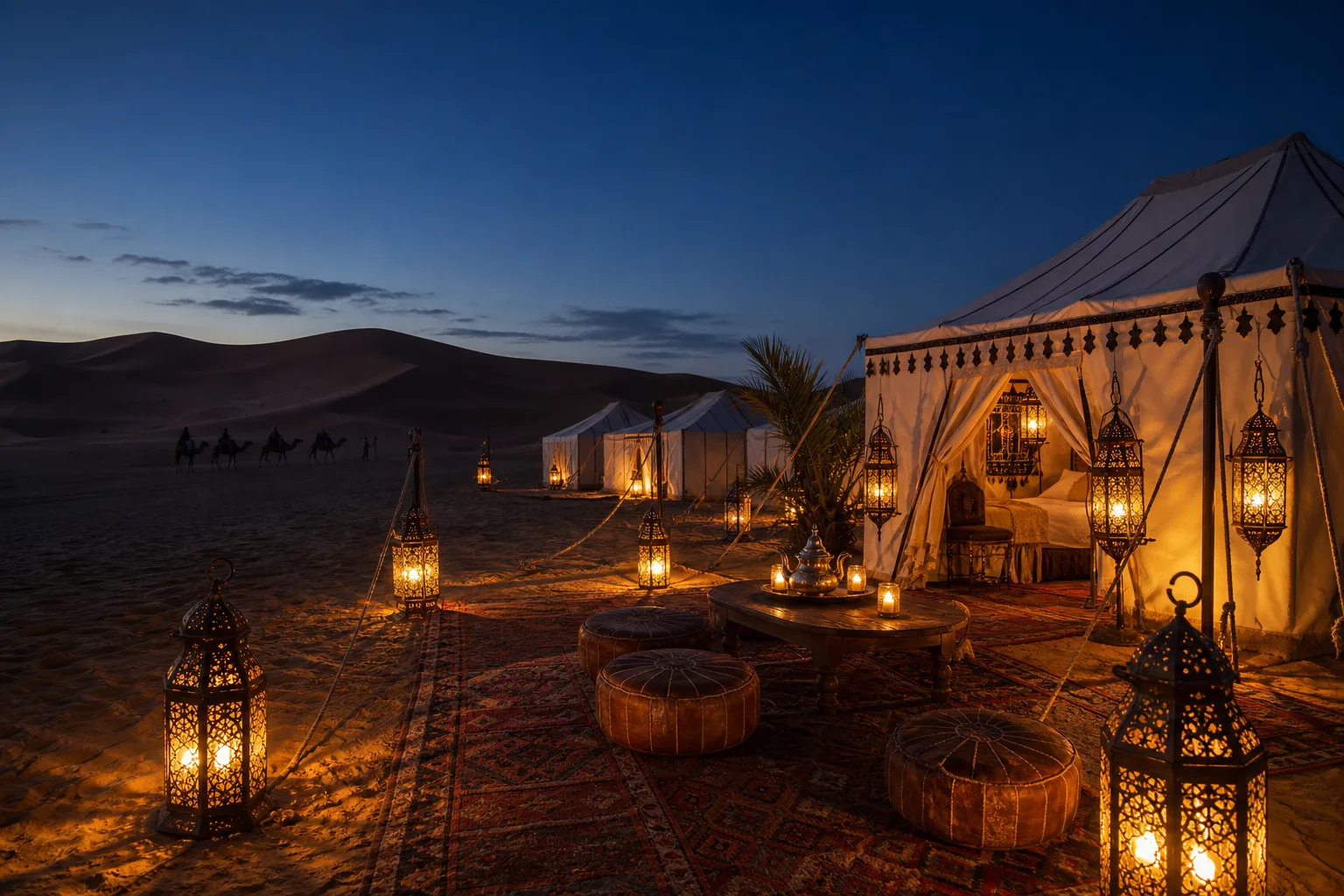
The short answer: a shared group 3-day Sahara tour from Marrakech to Merzouga usually runs about $100–200 per person; a private 3-day trip for two starts around $350–600 per person and rises with a better camp; and a 4-day private trip to remote Erg Chigaga is roughly $400–700 per person, or $800–1,200+ at the luxury end. A quick 2-day Zagora trip can be as little as $60–120 per person shared. Those are real market ranges, not a quote — and the reason no honest operator gives you one flat figure is that three things move the price hard: the camp standard, whether the tour is private or shared (and how many of you there are), and the length, route and season. Here's how it all fits together, what's usually left out of the headline price, and how to compare two quotes fairly.
Typical price ranges at a glance
Per person, in USD, as a planning guide. Shared means a seat on a small-group departure; private means the vehicle and driver-guide are yours. Camp standard and season can move any of these up.
| Tour | Shared (pp) | Private (pp) |
|---|---|---|
| 2-day Zagora / 1 night | ~$60–120 | ~$150–300 |
| 3-day Merzouga / 2 nights | ~$100–200 | ~$350–600 |
| 4-day Erg Chigaga / 3 nights | ~$180–320 | ~$400–700 |
| Luxury camp (any length) | limited | ~$800–1,200+ |
Indicative market ranges for planning, not a quote. Private per-person costs fall as your group grows, since you split one vehicle and driver between you.
The three things that move the price most
Two tours can look identical and be priced far apart. Nine times out of ten, the difference is one of these three.
Camp standard
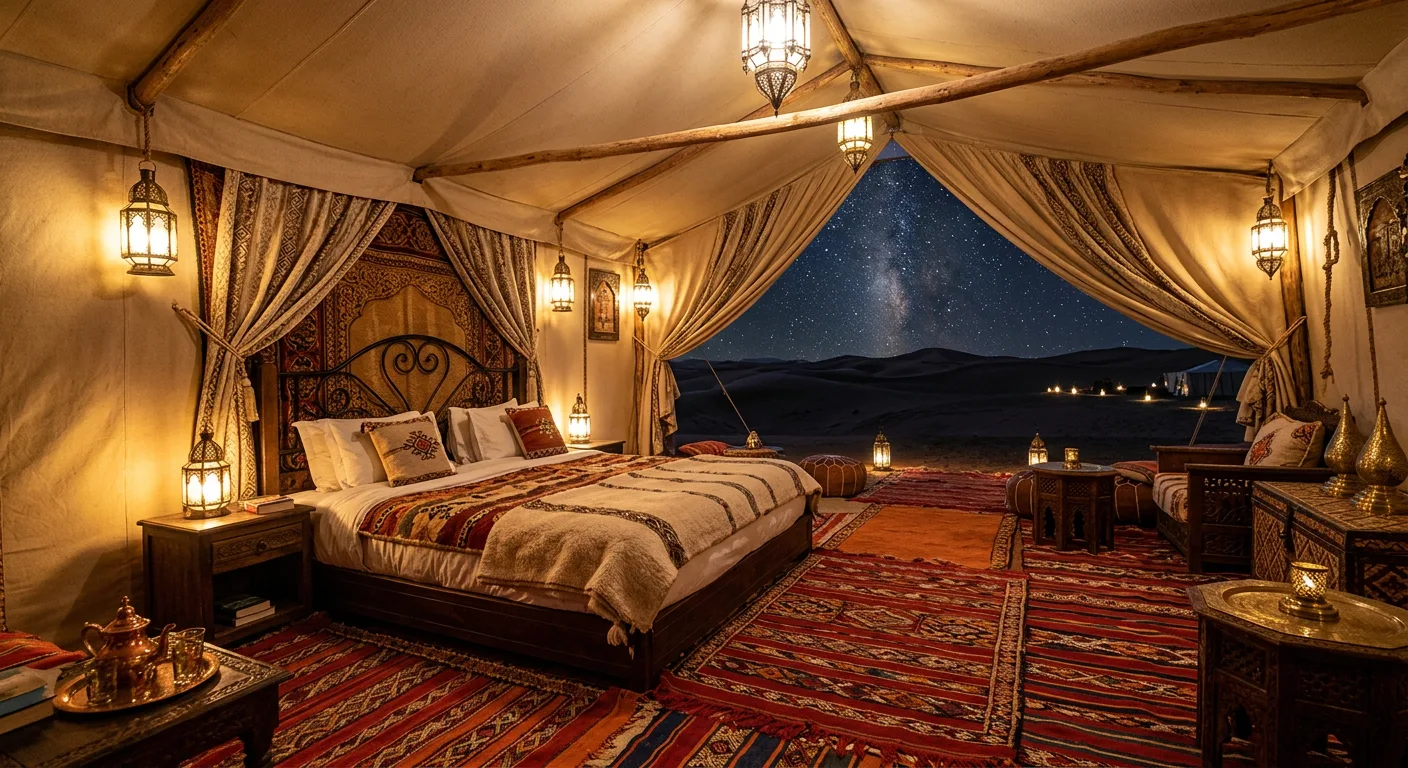
The biggest single variable. A basic Berber tent with shared facilities sits at the bottom; a private, en-suite luxury tent with proper beds and heating can multiply the camp portion of the price. Decide this first — it shapes the quote more than anything else.
Private vs shared, and group size
A shared seat is cheapest. A private tour costs more, but you split one vehicle and driver — so the per-person price drops sharply with four to six people and can approach shared rates for a family or group.
Length, route and season
A 2-day Zagora trip is the cheapest; 3 days to Merzouga is the classic; 4 days to remote Erg Chigaga costs more for the extra night and 4x4 work. Peak months (Oct–Apr) and holidays push prices up.
Shared vs private — the real trade-off
A shared departure is the cheapest way into the desert: you split a minibus with other travellers, which keeps the per-seat price low but fixes the pace and the stops. A private tour costs more per head for two people — but the gap shrinks quickly as the group grows, because you're dividing one vehicle and driver-guide rather than buying seats. For a family or a group of four to six, private can land close to shared pricing while giving you your own schedule. We lay the two out side by side in our private vs shared desert tour comparison.
Standard vs luxury camp
If two quotes for the same trip are far apart, the camp is usually why. "Desert camp" stretches from a simple Berber tent with shared facilities to a private, en-suite luxury tent with proper beds, heating and a real bathroom — and the gap in both comfort and cost is large. Decide the standard you actually want before you compare prices. Our where to stay in the Sahara guide walks through the tiers, and the luxury vs standard camp comparison shows exactly what the upgrade buys.
The cheapest way: doing it by bus
If saving money is the priority, the floor is the public coach. A CTM or Supratours bus from Marrakech to Merzouga is only about 200–350 MAD ($20–35) each way — but that's just transport, and an overnight one at that. You then book the camp, the camel trek and any local transfers yourself, and you give up the door-to-door ease and the roadside stops of a tour. Once you add a camp night and the trek, the total often isn't far below a cheap shared tour. It's a real option for confident, time-rich travellers; for everyone else, the bus saving rarely justifies the hassle.
Getting there matters too: Merzouga is a long way from Marrakech, and how you cover that distance affects both cost and time. Our guide to getting from Marrakech to Merzouga compares the tour, transfer, bus and self-drive options in full.
What the headline price leaves out
The cheapest quote isn't always the cheapest trip — sometimes it's just the one that includes the least. These are the usual extras to budget for on top of any quote.
Lunches, drinks & entry fees
Dinner and breakfast at camp are usually in; lunches on the road, drinks beyond mint tea, and small site entry fees (for example at Aït Ben Haddou) are typically pay-as-you-go.
Tips for your guide and camp team
Gratuities aren't in the price. Modest and discretionary, but a tip for your driver-guide and the camp crew is customary in Morocco — budget a small amount.
Optional activities & upgrades
Sandboarding, quad bikes, an extended camel ride, a luxury-camp upgrade or a single supplement for solo travellers all sit on top of the base price.
Compare like for like: before you judge two prices, check each covers the same nights, camp standard and meals. Our guide to what's included and what costs extra gives you the exact questions to ask of any quote.
Our honest take on value
A Sahara tour is usually better value than the sticker suggests, because the expensive parts — the driving, the camp, the camel trek and the camp meals — are baked in. The cheapest shared trips are fine for many travellers; the money is best spent not on a flashier brochure but on the two things you actually feel: a better camp and a private vehicle if your group can share the cost. Work out how many days you want first — our how many days do you need for the Sahara guide helps — then decide the camp standard, and the price makes sense from there. For the bigger picture, our is a Sahara tour worth it piece and our Morocco on a budget guide are good companions.
When you're ready to put real numbers to it, our 3-day Marrakech-to-Merzouga tour, quicker 2-day Zagora trip and remote 4-day Erg Chigaga expedition each set out what's included on the page — and if a luxury desert camp is what you're after, we'll quote the upgrade plainly before you commit.
Frequently asked
How much does a Sahara desert tour from Marrakech cost?
As a rough guide, a shared group 3-day tour to Merzouga usually runs about $100–200 per person, while a private 3-day trip for two travellers typically starts around $350–600 per person and climbs from there with a better camp or vehicle. A quick 2-day Zagora trip can be as little as $60–120 per person shared, and a 4-day private run to remote Erg Chigaga with a good camp is often $400–700 per person, or $800–1,200+ at the luxury end. The single number always depends on camp standard, group size and season.
Why are some Sahara desert tours so cheap?
A very low headline price almost always means a shared minibus on a fixed schedule, a basic Berber camp with shared facilities, and a list of extras you pay as you go — lunches, drinks, entry fees and activities. None of that is dishonest, and a cheap shared tour can be genuinely good value. The ones to be wary of are the rock-bottom tours sold on the street around Jemaa el-Fna, where the saving sometimes comes from a rushed pace, an over-packed vehicle or a camp that doesn't match the photos. Always check what's actually included before comparing prices.
How much more is a private desert tour than a shared one?
A private tour costs noticeably more than a shared seat — but the gap narrows fast as your group grows, because you're splitting one vehicle and driver between you rather than paying per seat. For two people the per-person premium is real; for a family or a group of four to six, a private tour can land close to shared pricing while giving you your own schedule, the freedom to stop where you like, and a driver-guide to yourselves. You're paying for exclusivity and flexibility, not a different camp or route.
How much does a luxury desert camp add to the price?
Camp standard is the biggest single swing in any quote. A standard Berber tent with shared or simple facilities sits at the bottom; a luxury en-suite tent with proper beds, heating and private bathrooms can multiply the camp portion of the cost. In practice a luxury-camp tour often runs from around $800 per person upwards on a multi-day private trip, against a couple of hundred for a basic shared one. Solo travellers should also budget for a single supplement, which applies most camps charge for a tent to yourself.
Is it cheaper to do the Sahara independently by bus?
On paper, yes — a CTM or Supratours coach from Marrakech to Merzouga is only about 200–350 MAD ($20–35) each way. But that just gets you to the dunes; you then arrange the camp, the camel trek and any transport separately, and you spend roughly 13 hours each way on a fixed timetable. Once you add a night's camp and the trek, the total often isn't far off a cheap shared tour — and you've done all the logistics yourself. The bus suits confident, budget-first travellers with time to spare.
What isn't included in the headline price?
Most multi-day tours include private transport, the desert camp, the camel trek and dinner and breakfast at camp. What's usually extra: lunches on the road, drinks beyond camp mint tea, tips for your driver-guide and camp team, small site entry fees, optional activities like sandboarding or quad bikes, and any upgrade to a luxury camp or single tent. None of it is hidden, but it adds up, so budget a modest amount on top of the quote. We break this down fully in our guide to what a tour includes and what costs extra.
Does the price change with the season?
Yes. The peak desert months — roughly October to April, when the weather is best — bring the highest demand and firmest prices, especially around Christmas, New Year and Easter. The hot summer months of June to August are quieter and often cheaper, but daytime heat at Erg Chebbi can be punishing, so the saving comes with a real trade-off. Spring and autumn give you the best conditions, which is also when camps fill earliest, so booking ahead matters more than haggling for those dates.
A clear price, everything spelled out
Tell us your dates, group size and camp, and we'll quote it honestly.
From a simple shared trip to a private tour with a luxury camp, Sahara Desert Adventures will set out exactly what's included and what isn't — in writing — so you know precisely what you're paying for before you commit.
Get my desert quote