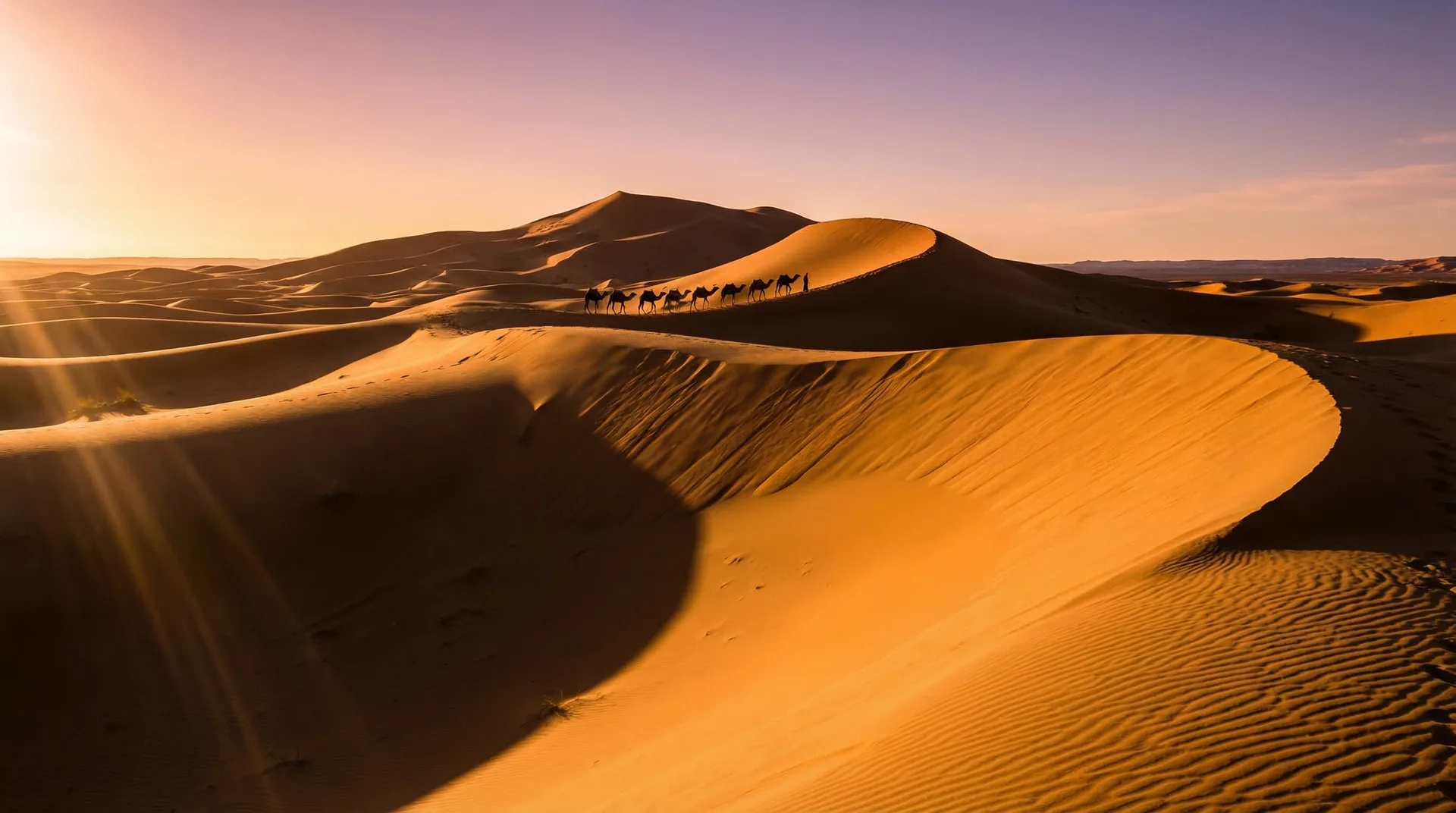
"Where should we stay in the desert?" is two questions wearing one coat: which part of the Sahara you head for, and what kind of bed you want when you get there. Get those two right and the rest of the trip falls into place. Below we walk through the areas worth knowing, then the real decision — a night out in a desert camp versus a kasbah hotel on the dune edge — with the comfort tiers explained plainly and no camps named or rated.
First, choose your area
Morocco's Sahara isn't one place. The three areas below cover where almost everyone ends up, and they suit different travellers. There's no single "best" — just the best for your time, your appetite for driving, and how wild you want it.
Merzouga & Erg Chebbi — the big, accessible dunes
Erg Chebbi, reached through the village of Merzouga in the far south-east, holds the tall, sweeping dunes most people picture when they think "Sahara". It also has the widest choice of places to sleep by a distance: village kasbah-hotels built right on the dune edge and desert camps out in the sand, running from simple standard set-ups all the way to luxury "bubble" and stargazer camps. If you're not sure where to go, this is usually the easiest answer.
Who it suits: most travellers, first-timers, families, and anyone who wants options at every comfort level in one place.
Zagora & the Draa Valley — closer and quicker
Zagora and the date-palm ribbon of the Draa Valley sit much closer to Marrakech, which is their whole appeal. The trade-off is honest: the dunes here are smaller than Erg Chebbi, so the landscape is gentler than the postcard. Accommodation skews toward simpler camps and kasbah stays.
Who it suits: short trips and tight schedules — people who want a taste of the desert without the long haul east.
M'Hamid & Erg Chigaga — remote and wild
Past the end of the tarmac at M'Hamid lies Erg Chigaga: big dunes again, but reached by a stretch of 4x4 over open piste. Fewer people make it out here, so it feels genuinely remote and undeveloped — fewer camps, less infrastructure, more silence.
Who it suits: travellers specifically chasing deep desert and solitude, who don't mind a rougher journey to earn it.
Then, the real decision: camp vs kasbah hotel
Once you've picked an area, the choice that defines your night is where you actually sleep. The two classic options pull in different directions.
A night in a desert camp — the classic
This is the experience people travel for. You head out into the sand — by camel or by 4x4 — to a camp pitched among the dunes. There's dinner, usually communal, then an enormous sky of stars with no light pollution, and a sunrise over the dunes if you can drag yourself up for it. It's atmospheric and a little adventurous by design. The flip side: it's less convenient, you're committed to being out there, and comfort depends entirely on the tier you book.
A kasbah hotel on the dune edge — comfort and ease
A kasbah-style hotel sitting at the edge of the dunes keeps you close to a road, with the sand right outside. You typically get ensuite rooms, a pool, reliable hot water and easy in-and-out — no camel commitment to reach your bed. You still walk out onto the dunes for sunset and stars; you just sleep with more comfort and flexibility. It's the call we most often suggest for families with young children, travellers with mobility needs, or anyone wanting a relaxed base.
Plenty of travellers refuse to choose and do both — a hotel night to arrive, settle and clean up, then a camp night for the full dunes experience.
Comfort tiers, explained honestly
"Camp" covers a wide range, so it's worth knowing what the tiers actually mean before you book. We don't name or rate specific operators here — quality varies and you should confirm what's included — but the shape of the tiers is consistent.
| Tier | What you typically get | Best for |
|---|---|---|
| Standard camp | Simpler tents, sometimes shared bathroom blocks, basic bedding, communal dinner | Budget travellers, one-night stays |
| Comfort / ensuite camp | Private ensuite tents, proper beds, rugs, heating for cold nights, multi-course dinner | Most travellers wanting privacy and warmth |
| Luxury / bubble / stargazer camp | Large suite or clear-domed tents to watch the sky, fuller service and dining | Special occasions, comfort-first guests |
| Kasbah hotel (dune edge) | Ensuite rooms, pool, hot water, easy road access — sleep off the sand | Families, mobility needs, relaxed bases |
A few honest expectations
Most people stay one or two nights. That's enough for sunset, dinner, stars and sunrise; a second night just lets you slow down and walk further. You don't need a week.
Getting there is a long drive. Merzouga is roughly nine to ten hours from Marrakech, Zagora around five to six. Set the expectation early — most travellers break the Merzouga journey with a night en route rather than enduring it in one go. The road there is part of the trip, not a tax on it.
Still weighing the areas against each other? Our Merzouga vs Zagora comparison goes deeper on dune height, drive time and who each gateway suits. And you can browse our desert tour options here.
Frequently asked
Should I sleep in a desert camp or a kasbah hotel on the dune edge?
Both are valid — they just sell different nights. A desert camp is the classic: you ride a camel or take a 4x4 out into the sand, eat dinner under the stars, and wake for sunrise on the dunes. A kasbah hotel on the dune edge keeps you closer to a road, usually with a pool, ensuite rooms and easy in-and-out — the call most people make when travelling with young children, with mobility needs, or simply wanting a comfortable base. Many of our guests do one of each: a hotel night to arrive and clean up, then a camp night for the real thing.
Where in the Sahara should I actually stay?
For most first-time travellers we point to Merzouga, on the edge of Erg Chebbi — it has the tallest, most photogenic dunes and by far the widest choice of places to sleep, from kasbah-hotels on the sand's edge to camps deep in the dunes at every comfort level. If your trip is short or you're coming quickly from Marrakech, Zagora and the Draa Valley are closer but the dunes are smaller. If you want remote and wild, M'Hamid and Erg Chigaga are reached by 4x4 and see far fewer people.
What's the difference between a standard and a luxury desert camp?
Comfort tiers mostly come down to the tent. Standard camps tend to have simpler tents, sometimes with shared bathroom blocks, basic bedding and a communal dinner — perfectly comfortable for a night, and the stars are the same overhead. Step up and tents become private and ensuite, with proper beds, rugs, heating for cold nights and multi-course dinners. At the top, so-called 'luxury', 'bubble' or 'stargazer' camps add clear-domed or large suite tents you can watch the sky from. We don't name or rate specific camps here — comfort and quality vary, so it's worth checking what each tier actually includes before booking.
How many nights should I spend in the desert?
Most travellers do one or two nights, and that's genuinely enough to get the experience — sunset, dinner, a star-filled night and sunrise. A second night lets you slow down, walk further into the dunes and avoid feeling rushed. Longer multi-night treks exist, mostly out of M'Hamid, but they're for travellers specifically chasing deep-desert time.
How long is the drive to the Sahara from Marrakech?
Set expectations honestly: it's a long way. Merzouga is roughly nine to ten hours by road, which is why most people break the journey with a night en route rather than driving it in one push. Zagora is shorter at around five to six hours, which is part of why it suits tight schedules. Wherever you go, the getting-there is a real part of the trip, not an afterthought.
Is a desert camp suitable in winter?
Yes, but pack for cold. Desert nights from roughly November to February get genuinely cold once the sun drops, even when days are mild. The better ensuite camps provide heavy blankets and often heating; standard camps rely more on layers and a good sleeping setup. Daytime in winter is usually pleasant for walking the dunes, which is why it remains a popular season.
Ready for the dunes?
We match you to the right area, camp tier and base.
Tell us your dates, comfort level and how wild you want it — Sahara Desert Adventures will recommend where to stay and secure the right camp or kasbah for your trip.
Request an itinerary