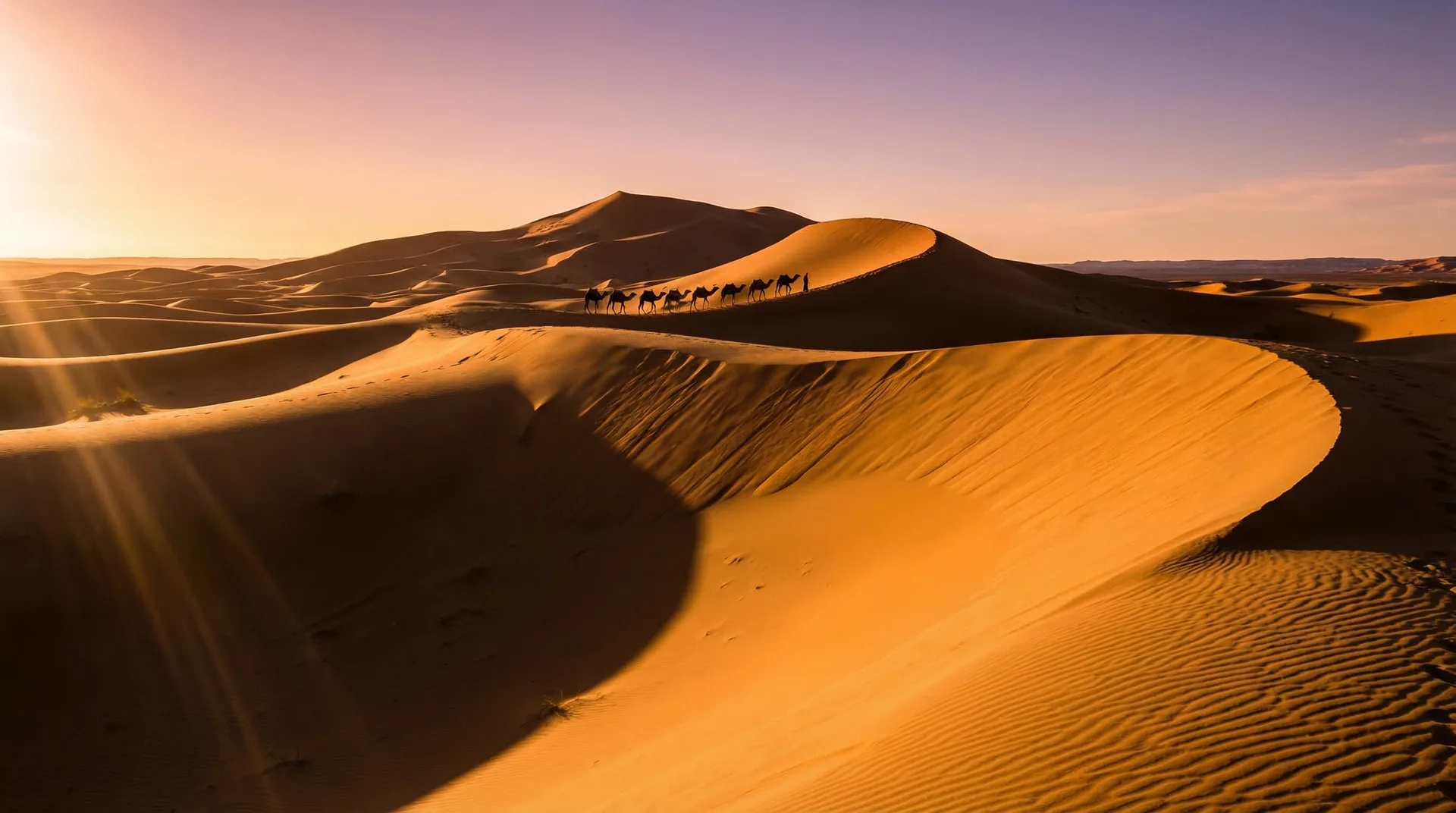
It's the first question almost everyone asks us about the desert: how many days do you actually need for the Sahara? The honest answer is that it depends on where you start, which dunes you want, and how much time you're willing to spend in the vehicle. The single biggest factor is the drive — the deep desert at Merzouga and Erg Chebbi is a long way from both Marrakech and Fes, and the road itself is part of the trip. Here's how the realistic options break down.
2 days, 1 night — the rushed minimum
Two days and one night is the absolute minimum, and we'll be straight with you: for the far dunes it's rushed. It's a long drive each way across the High Atlas, so a 2-day round trip to Merzouga ends up being mostly time on the road with very little time on the sand. A 2-day trip really only works well from a closer base, or as a fast taste of the desert rather than the full experience. If two days is all you have, the smaller, nearer dunes around Zagora suit it far better than far-off Merzouga — you spend less of your short trip driving and more of it in the desert.
3 days, 2 nights — the classic, and what we recommend
This is the one. Three days and two nights is the classic, recommended length for the Merzouga and Erg Chebbi trip from Marrakech, and for most people it's the sweet spot. It gives the long drive room to breathe and leaves proper time on the kasbah route — the great earthen citadel of Aït Ben Haddou, and the dramatic Dadès and Todra gorges — instead of flashing past them. Just as importantly, it buys you a real night in the dunes: sunset over the sand, a night at a desert camp, and the unforgettable sunrise — not just a quick stop and a turnaround. Three days is enough to feel like you actually went to the desert, rather than merely drove to it and back.
4+ days — relaxed, the crossing, or the remote dunes
Give the desert four days or more and you open up three good options. First, simply a more relaxed pace — less driving per day, more time to stop, walk and linger. Second, the one-way Marrakech-to-Fes desert crossing (or the reverse): instead of doubling back along the same road, you start in one city and finish in the other, seeing everything in between without backtracking. Third, the remote Erg Chigaga dunes — wilder and far less visited than Erg Chebbi, but they need a 4x4 and more time to reach. If your schedule allows it, the desert genuinely rewards the extra days.
The honest verdict
If you only do the Sahara once, three days and two nights is the sweet spot for the classic trip. It's long enough to do the kasbah route justice and to spend a real night in the dunes, without the trip becoming an exhausting marathon of driving. Our one firm piece of advice: don't try to do Merzouga as a single overnight from Marrakech — it's simply too much road for too little desert. If you're short on time, point a 2-day trip at the nearer Zagora dunes instead; if you have time to spare, four days and the one-way crossing is a wonderful way to see it all.
Tell us how many days you have and we'll build the pacing around it honestly. You can browse our desert tour options here or tell us your dates and we'll advise on the right length for your trip.
Frequently asked
How many days do you need for the Sahara desert?
For the classic trip to Erg Chebbi and Merzouga from Marrakech or Fes, three days and two nights is the sweet spot. That gives you proper time on the kasbah route — Aït Ben Haddou, the Dadès and Todra gorges — plus a real night in the dunes with sunset and sunrise, rather than a tiring blur of driving. Two days and one night is the bare minimum and works better as a fast taste from a closer base or to the smaller Zagora dunes. Four or more days lets you slow right down, do the one-way Marrakech-to-Fes crossing, or reach the remote Erg Chigaga.
Can you do the Sahara in 2 days from Marrakech?
Honestly, not Merzouga and Erg Chebbi — that is too much driving for two days. It is a long haul each way across the High Atlas, so a 2-day, 1-night round trip to the far dunes ends up being mostly time in the vehicle with very little time on the sand. A 2-day trip works far better as a fast taste from a closer base, or aimed at the smaller, nearer dunes around Zagora rather than far-off Merzouga. If your heart is set on the big Erg Chebbi dunes, give it three days.
Is 3 days enough for the Sahara desert?
Yes — three days and two nights is the recommended length for the classic Sahara trip to Merzouga and Erg Chebbi, and for most people it is the ideal. It breaks the long drive sensibly, leaves real time for the highlights of the kasbah route, and gives you a proper desert night with the dunes at sunset and sunrise. It is the format most of our travellers choose, and the one we recommend if you only do the desert once.
When is it worth spending 4 or more days in the Sahara?
Four-plus days is worth it in three situations. First, if you simply want a more relaxed pace with less driving per day. Second, if you want the one-way Marrakech-to-Fes (or Fes-to-Marrakech) desert crossing, which lets you see everything without backtracking along the same road. Third, if you want to reach the remote Erg Chigaga dunes, which need a 4x4 and more time than Erg Chebbi. If you have the days to spare, the desert rewards a slower trip.
Should you do Merzouga as a single overnight from Marrakech?
We would steer you away from it. Trying to do Merzouga and Erg Chebbi as one quick overnight from Marrakech means a punishing amount of driving for very little desert time. The far dunes deserve three days. If your schedule only allows a single overnight, you are better off with the nearer, smaller Zagora dunes, which suit a short trip far better than far-off Merzouga.
Not sure how many days to give the desert?
We'll match the trip length to your dates — and tell you honestly when it's too rushed.
Tell us where you're starting and how long you have, and Sahara Desert Adventures will advise on whether to aim for Merzouga or Zagora, whether the one-way Marrakech-to-Fes crossing fits, and how to pace each day so the drive never swallows the trip.
Request an itinerary