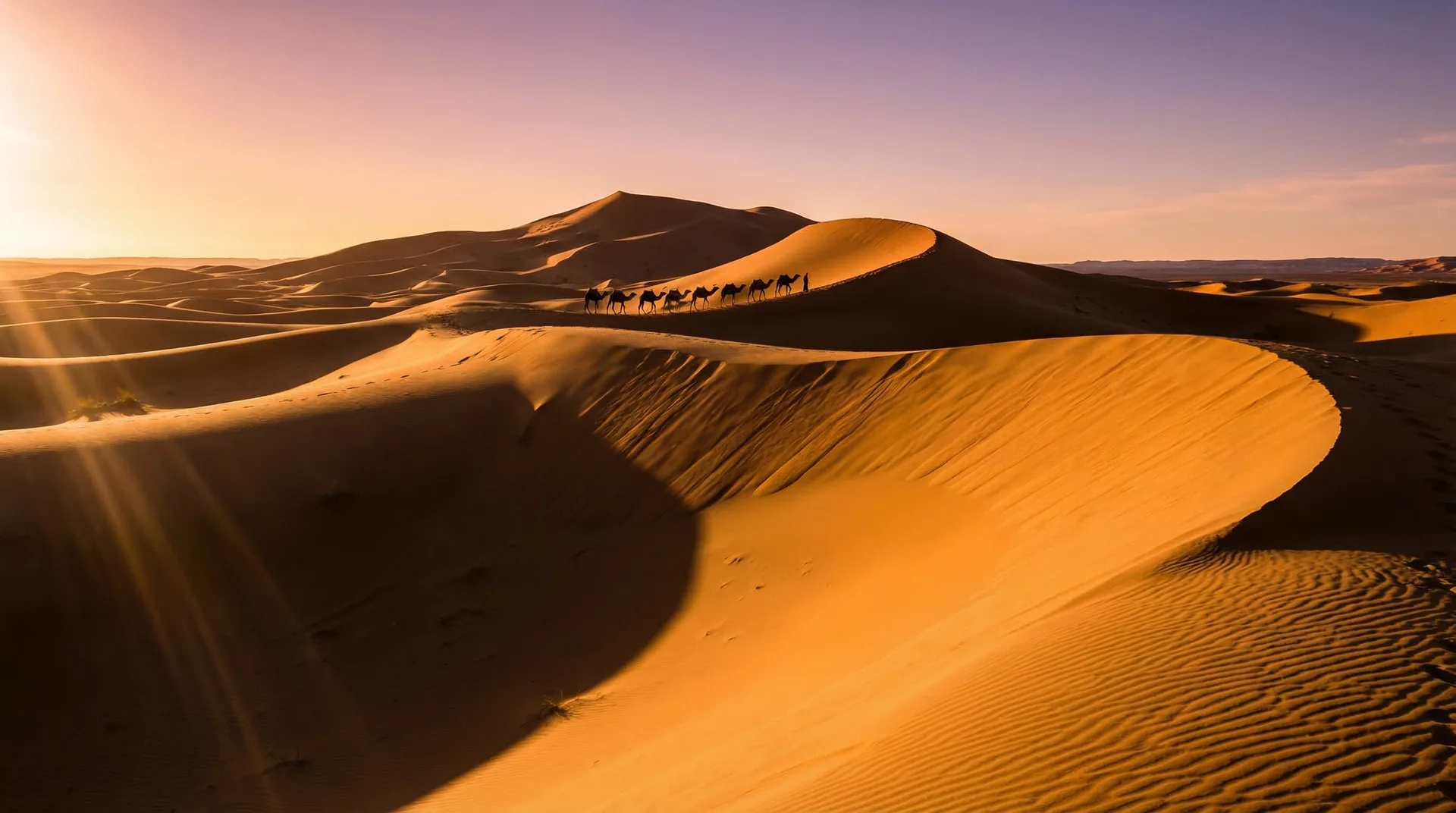
A Sahara desert tour is a multi-day road trip from Marrakech or Fes out to the dunes — Erg Chebbi at Merzouga or Erg Chigaga beyond M'hamid — that ends with a camel trek over the sand and a night in a tented camp under the stars. You spend the days driving through dramatic, ever-changing scenery — Atlas passes, palm oases, kasbahs and red-rock gorges — and the trip peaks in the late afternoon when you swap the vehicle for a camel, ride into the dunes as the sun drops, eat a tagine dinner by lantern light, sleep under canvas, and wake for sunrise over the sand. Most travellers describe it as the most memorable part of their entire Morocco trip. Here's the honest, first-hand walkthrough of how a day in the desert actually unfolds.
The desert tour, hour by hour
Routes and timings vary, but almost every classic Merzouga or Zagora tour follows the same arc: a long, scenic drive out, the camel trek into the dunes at golden hour, an evening at camp, the stars, and a sunrise before the road home. Here's how the day flows.
Day 1 · Morning
The long, beautiful drive out
You leave Marrakech or Fes early and climb out of the city. From Marrakech the road crosses the High Atlas over the Tizi n'Tichka pass, with kasbahs, switchbacks and snow-tipped peaks; from Fes you drop through cedar forest and the Middle Atlas. The driving is a real part of the trip, not just transit — the scenery changes hour by hour from mountains to palm oases to bare, cinematic plateau.
Day 1–2 · Midday
Kasbahs, gorges and oases
Most routes break the drive at landmarks: the mud-brick film-set village of Aït Ben Haddou, the Dadès and Todra gorges with their towering red walls, and the long green ribbon of the Ziz Valley palm groves. You stop to walk, photograph and eat lunch. On a 3-day trip these are unhurried; on a 2-day dash they pass quickly.
Late afternoon
Camels, and the ride into the dunes
You reach the edge of the sand — Erg Chebbi near Merzouga, or Erg Chigaga beyond M'hamid — in the late afternoon. Here you swap the vehicle for a camel (or a 4x4 if you prefer), and a guide leads you on foot into the dunes for around an hour, timed so you crest the sand as the light turns gold and the sun sinks. This is the moment most people came for.
Evening
Camp, tagine and drums by the fire
At camp you're shown to your tent, then gather for sweet mint tea and a cooked dinner — soup, a tagine, bread and fruit — served by lantern light. Many camps bring out drums for live Gnaoua-style music around a fire. The mood is calm and communal; phone signal is patchy to none, which is rather the point.
Night
The clearest stars you'll ever see
Once dinner winds down, people drift away from the camp lanterns, lie back on the still-warm sand, and look up. With no light pollution, dry air and clear skies, the night sky over the dunes is staggering — the Milky Way, shooting stars, planets. Then it's into a canvas tent under thick blankets. The desert turns genuinely cold after dark, every season.
Next morning
Sunrise, then the road back
You wake early — it's worth it — to watch the sun rise over the dunes, the sand shifting from grey to pink to deep gold as the light returns. After breakfast you ride or drive back out to the vehicle and begin the journey home, or continue onward if you're doing a Marrakech-to-Fes crossing.
How long does a desert tour take — and where does it go?
The single biggest thing to understand is that the great dunes are a long way from the imperial cities. That distance shapes everything. The realistic minimum from Marrakech is a 2-day / 1-night trip; the classic sweet spot is 3 days / 2 nights, which gives you the dunes without punishing back-to-back drive days. A Marrakech-to-Fes (or Fes-to-Marrakech) desert crossing is usually 3 days, and reaching remote Erg Chigaga or doing the grand loop runs to 4 days or more. A genuine day trip to the big dunes and back simply isn't possible — only the small Agafay stone desert near Marrakech works as a day outing, and that's a different, gentler experience. For the full breakdown, see how many days you need for the Sahara, and to choose between the two great sand seas, our Merzouga vs Zagora comparison.
The short version: Merzouga and Erg Chebbi are the most popular and accessible big dunes, with the easiest road access and the widest choice of camps. Erg Chigaga, beyond M'hamid, is more remote, quieter and reached by 4x4 — better if you want fewer people and a wilder feel. Zagora's dunes are smaller but closer, making them the choice for the shortest trips.
Is a Sahara desert tour worth it?
For the overwhelming majority of travellers, the answer is yes, emphatically. But it's worth being honest about both sides, because the desert isn't a casual add-on — it's a real commitment of time. Here's the straight assessment.
Why it's worth it for most people
The dunes are the real thing — vast, silent and genuinely beautiful — and a quiet night under the desert sky is the kind of memory people describe years later. For first-time visitors to Morocco, it's very often the highlight of the whole trip.
The one honest catch: the driving
The big dunes are a long way from the cities. A worthwhile trip needs two days minimum and ideally three. If you only have a single free day, the real desert isn't reachable and back — and a rushed dash there and back can sour the experience.
Our honest verdict: if you have at least two free days and you're not fundamentally averse to long drives, go — the dunes and the night under the stars are worth far more than the hours in the vehicle. If you only have a single spare day, skip the deep desert rather than rush it, and consider an Agafay sunset evening near Marrakech instead. The desert rewards travellers who give it time and disappoints those who try to tick it off.
What's the camel trek and the camp really like?
Two things travellers worry about most: the camel trek and sleeping in a tent. Both are far easier than people fear. The camel ride is gentle and slow — a guide leads the animals on foot, so you're never steering or controlling them. The only real knack is the lurch when the camel stands and sits (lean back, then forward) and a little saddle soreness on a longer ride. It suits most ages and fitness levels, and anyone who'd rather not ride can reach camp by 4x4 instead.
The camp itself scales with what you book. Standard camps are simple but clean, with shared washing facilities and basic tents; lodge-grade and luxury camps offer private en-suite tents, real beds, rugs and proper multi-course dinners. Either way you get the same sky, the same silence and the same sunrise. For the full picture of a night under canvas, read staying in a desert camp and our deeper guide to Sahara desert camps explained.
What to expect — and what to pack
The desert is hot by day and genuinely cold at night, in every season — that single fact drives most of what you bring. Pack a small overnight bag you carry to camp (your main suitcase often stays in the vehicle or in town): warm layers for the cold night and the sunrise, a sun hat, sunglasses, sunscreen, a scarf for blowing sand, a power bank, a head torch and any medication. Phone signal at camp is patchy to none, so download maps and music in advance. For the complete list, see our Sahara packing guide, and for why the nights bite, read is it cold in the Sahara at night.
The honest verdict
A Sahara desert tour isn't a quick excursion — it's a journey, with real hours on the road and a genuinely cold night under canvas. But what you get in return is the rarest thing a modern trip can offer: silence, a sky full of stars with no light to dim them, and the slow gold light of sunrise over an ocean of sand. For most travellers it's worth every kilometre, and very often the part of Morocco they remember most. Give it the days it deserves, pack for the heat and the cold, and the desert will repay you many times over.
If you'd like us to build the route, the camp and the pacing around your dates, browse our desert tour options or tell us when you're coming and we'll advise honestly on what's worth it for your trip.
Frequently asked
What is a Sahara desert tour in Morocco actually like?
A classic Sahara desert tour is a multi-day road trip from Marrakech or Fes out to the dunes at Merzouga (Erg Chebbi) or Zagora/M'hamid (Erg Chigaga), ending with a camel trek over the sand and a night in a tented camp under the stars. You spend the days driving through dramatic, changing scenery — Atlas passes, palm oases, kasbahs and gorges — and the highlight comes in the late afternoon when you swap the vehicle for a camel, ride over the dunes as the sun drops, eat a tagine dinner by lantern light, sleep in a canvas tent, and wake for sunrise over the sand. Most people describe it as the single most memorable part of their Morocco trip.
Is a Sahara desert tour worth it?
For the overwhelming majority of travellers, yes — emphatically. The dunes of Erg Chebbi and Erg Chigaga are genuine, towering sand seas, not a token patch of desert, and a night in a quiet camp under one of the clearest night skies on Earth is something people remember for years. The main caveat is the driving: the desert is far from the imperial cities, so a worthwhile trip needs at least two days and ideally three. If you only have a single spare day, the desert is not realistically reachable and round-trip; in that case it is better skipped than rushed.
How long does a Sahara desert tour take?
The realistic minimum from Marrakech is a 2-day / 1-night trip, which is long but doable. The classic sweet spot is 3 days / 2 nights, which gives you the dunes without exhausting back-to-back drive days. A Marrakech-to-Fes (or Fes-to-Marrakech) desert crossing is usually 3 days, and reaching remote Erg Chigaga or doing the grand loop runs to 4 days or more. A genuine day trip to the big dunes and back is not possible from the cities — only the small Agafay 'desert' near Marrakech works as a day outing.
What happens on the first night in the desert camp?
You typically arrive at the edge of the dunes in the late afternoon, meet your camels, and ride into the sand for around an hour to reach camp as the sun sets. At camp you are shown to a tent, then gather for sweet mint tea, a cooked dinner — usually soup, tagine and fruit — and often live drumming around a fire. Afterwards people drift away from the lanterns to lie on the cool sand and watch the stars before sleeping under thick blankets. In the morning you wake early for sunrise over the dunes and ride or drive back out.
Is the camel trek hard or uncomfortable?
It is gentle and slow — the camels are led on foot by a guide, so you are not steering or controlling them. The ride to camp is usually around an hour. The main discomforts are the lurching motion when the camel stands up and sits down (lean back, then forward), and some saddle soreness on a longer ride. It suits most ages and fitness levels, and anyone who would rather not ride can reach camp by 4x4 instead. Wear long trousers, hold the saddle frame, and it is far easier than people expect.
What should I bring on a desert tour?
Pack a small overnight bag you carry to camp (your main suitcase often stays in the vehicle or town): warm layers for the cold night and sunrise, a sun hat, sunglasses, sunscreen, a scarf for blowing sand, a power bank, a head torch, and any medication. The desert is hot by day and genuinely cold at night in every season, so layering is the key. See our Sahara packing guide for the full list.
Are Sahara desert tours safe and comfortable?
Yes. Reputable desert tours run on well-travelled routes with experienced drivers and established camps, and the deep-desert region around Merzouga is a settled tourism area, not a wilderness expedition. Comfort scales with what you book: standard camps are simple but clean with shared facilities, while lodge-grade and luxury camps offer private en-suite tents, real beds and proper dinners. The two honest discomforts are the long drives and the cold nights — both easily managed with the right pacing and packing.
Thinking about the dunes?
We'll plan the route, the camp and the pacing so the desert is worth every kilometre.
Tell us your dates and how long you have — Sahara Desert Adventures will advise honestly on whether the deep desert fits your trip, which dunes suit you, and how to build a route you'll remember for years.
Request an itinerary