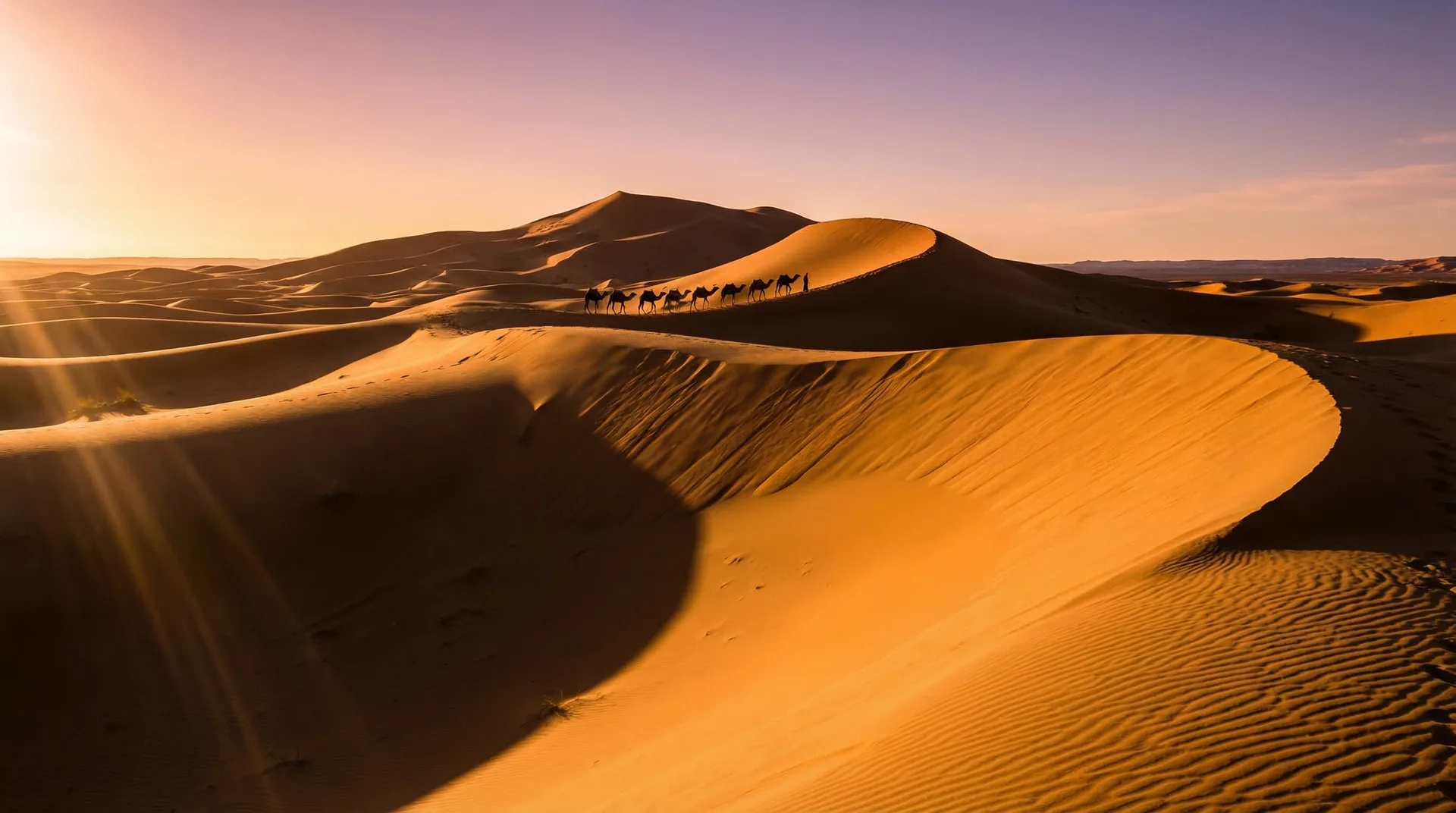
One night out on the sand is the part of a Morocco trip people are still recounting years later — the dunes turning copper at sundown, the dead quiet that settles in after midnight, a sky so free of light pollution you can trace the Milky Way and pick out Andromeda unaided. The catch is that "desert camp" stretches from a shared canvas tent on a rope cot to a standalone pavilion with a king bed, an open-air shower and your own terrace. We lay out the differences plainly here so nothing about your night catches you off guard.
Erg Chebbi (Merzouga) vs Erg Chigaga (M'Hamid)
Two great ergs — wind-built seas of sand — carry the overnight camps in Morocco. Erg Chebbi, behind the village of Merzouga in the Tafilalet, is the dune field you recognise from a hundred travel photos: a tight massif of burnt-orange crests topping out near 150 m, with camps lining the desert edge a short camel or quad ride out. Tarmac runs right to the staging point, Errachidia's airstrip puts it within flying distance, and the operator range is the widest in the country — rough bivouac through to polished lodge.
Erg Chigaga, some 50 km east of M'Hamid el-Ghizlane out past Zagora, is Morocco's largest erg and a far lonelier one. The final two hours are 4x4 work over open piste, and most travellers tack on a camel or quad leg to reach the tents. What you get in return is something close to total silence and a sliver of the foot traffic. We point travellers who have already ticked off Erg Chebbi — and anyone who treats solitude as the main event — toward Chigaga. Dig into our Sahara destination pages for the full picture on both ergs.
Bivouac and basic camps
The entry-level camps — the bulk of what operates at Erg Chebbi — pitch big canvas or Berber-style haima tents over simple iron or timber bed frames, dress them with plain cotton bedding, and share a cold-water toilet and shower block across every four to eight tents. Dinner lands as a communal tagine or couscous in a central marquee. Budget roughly US$40–80 per person, dinner, breakfast and a sunset camel ride included.
The experience is honest and frequently unforgettable, but the spread is wide — tent condition, kitchen standards and whether the plumbing actually works swing hard from one operator to the next. Booking on your own, read reviews dated within the last three months. Booking through us, you get a camp we have walked through ourselves.
Desert lodges and boutique camps
The upper tier has changed beyond recognition this past decade. The strongest now run standalone private tents of 30–50 m² with genuine king beds rather than cots, en-suite or adjacent private bathrooms plumbed for hot showers and flushing toilets, terrace seating, and occasionally a private plunge pool. The styling runs from pared-back Bedouin to a full riad aesthetic carried out into the dunes.
Dinner at a serious lodge is a sit-down, multi-course affair — harira to start, then pastilla, slow-cooked mechoui lamb and Moroccan sweets, laid at a candlelit table rather than ladled from a buffet. A resident musician usually plays once the plates are cleared. Reckon on US$200–600+ per person depending on the camp, the season and how exclusive it keeps itself. A few of the most isolated Erg Chigaga camps run as all-inclusive lodges and price to match.
What a night out actually covers
At any camp worth booking, the night reliably includes:
- Transfer from the village or roadhead to camp — camel, 4x4, quad or a mix, typically 20–60 minutes.
- The sunset dune session — most camps walk you onto a nearby crest for the last hour of light.
- Dinner — shared table or private service, depending on the tier.
- The tent itself — your bed for the night; comfort varies widely.
- Breakfast — bread, honey, olive oil, coffee and mint tea.
- The morning camel or 4x4 ride back to the road or village.
What is often left off the bill: alcohol (Morocco is a Muslim country — some camps will pour wine on request, others won't), sandboarding or quad hire (usually billed separately), telescope-led stargazing (a real extra at several good camps), and laundry.
Drive times and getting out there
Marrakech to Merzouga (Erg Chebbi): roughly 560 km over the Tizi n'Tichka and through Ouarzazate, 8–9 hours. We nearly always break it across two days with a stop in Ouarzazate or the Dades, so the road becomes part of the trip instead of a slog to be survived.
Fes to Merzouga: about 360 km via Midelt and Errachidia, 5–6 hours — doable in a day with an early start. Plenty of travellers run a Marrakech–Fes loop with the Sahara slotted in the middle.
Marrakech to M'Hamid (Erg Chigaga): around 530 km through Ouarzazate and Zagora, 7–8 hours to M'Hamid, then a further 2 hours of 4x4 piste to the erg itself. This is a committed journey best suited to travellers giving the Sahara at least two nights. See our Sahara tours for the multi-day routings.
When to come and what to pack
The standout windows are October–November and February–April. December and January run cold (lows around 5 °C or under) but hand you the quietest dunes of the year. July and August are brutal — 40 °C-plus by afternoon — even though the nights stay pleasant.
Pack these whatever the month: a mid-weight fleece or down layer for after dark, a headtorch, sunscreen, lip balm (the air is parching), a shemagh or scarf for blowing sand, and a power bank since charging at camp is limited. Grit works its way into everything — keep cameras in a sealed bag.
Frequently asked
Erg Chebbi or Erg Chigaga — which sand sea suits which traveller?
Erg Chebbi, the dune wall behind Merzouga, is the easier of the two to reach: tarmac runs to the camp staging point, the main crests sit a short camel ride away, and operators range from no-frills bivouacs to full-service desert lodges. Erg Chigaga, out beyond M'Hamid, is the wilder option — roughly two hours of rough piste from the last paved road and reached by 4x4, quad or a longer camel haul. Pick Chebbi for convenience and choice; pick Chigaga when emptiness and distance from other camps are the whole point.
How long is the road from Marrakech down to Merzouga?
Reckon on 8 to 9 hours and about 560 km, climbing over the Tizi n'Tichka and threading past Ouarzazate before the land flattens into pre-desert. We almost never drive it in a single push — an overnight in Ouarzazate or the Dades makes the day pleasant rather than gruelling. Travellers tight on time sometimes fly into Errachidia, the closest airstrip, and shave a full day off each leg.
What does a night at a proper desert camp actually buy you?
At a well-run camp the night covers a private or semi-private tent with real beds and bedding rather than thin mats, a private or en-suite toilet and shower, a multi-course Moroccan dinner built around tagine, couscous or mechoui, breakfast at first light, a sunset run by camel or 4x4 onto a high dune, and Gnaoua drumming around the fire afterwards. Better camps layer on telescope stargazing, a guided dawn walk over the ridges and quad outings.
Does the Sahara really get cold after dark?
Far colder than first-timers picture. With no cloud and no humidity, the heat drains out of the sand the moment the sun drops. October and March nights routinely fall to 5–8 °C; December through February can bring frost to the camp. Even in July and August, when nights hold around 20–25 °C, the 40 °C-plus afternoons make summer hard going. Whatever the month, a fleece earns its place in your bag.
When is the sweet spot for a Sahara trip?
Mid-October to late November and February through April are the windows we steer guests toward: warm days of 22–30 °C, cool but bearable nights, and the slanting light that makes the dunes glow. December and January trade warmth for solitude and the slim chance of frost-rimmed crests, a sight few travellers ever see. We only send peak-summer travellers out if they actively want the heat.
Is a camel essential for reaching the dunes?
Not at all. Camps at Erg Chebbi usually sit a 20–40 minute camel plod from the headline dunes, but a 4x4 covers the same ground faster and suits anyone with mobility concerns. At Erg Chigaga camel legs of an hour or two are common, though vehicles can reach the camps too. Quads are on offer at both ergs for a more energetic arrival. We match the transfer to each traveller rather than defaulting to one mode.
Ready to sleep under the Milky Way?
Every camp we put you in, we have walked through ourselves.
A Sahara Desert Adventures night in the dunes is fully private — your own vehicle, your own driver-guide and a camp our team has personally vetted. No shared coaches, no corners cut.
Plan a Sahara journey