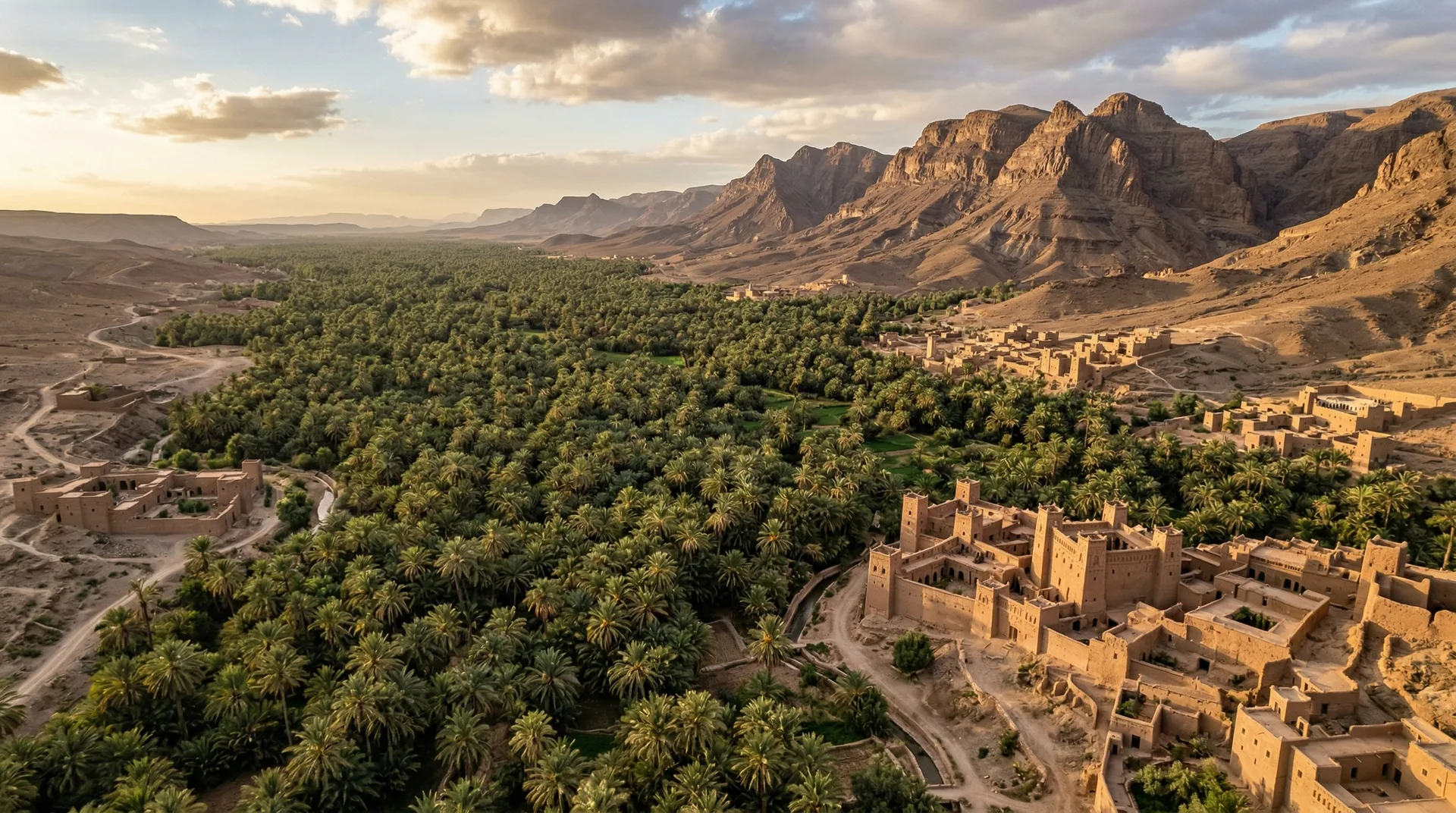
Zagora Town & Base: The Closer Desert Gateway from Marrakech
Zagora is the main town of the lower Draa Valley and the closer desert gateway when you are coming from Marrakech — reachable in roughly a long day's drive, shorter than the haul out to Merzouga. It is a practical palm-grove town rather than a sight in itself: a working market town strung along the Draa, with a palmeraie, old kasbahs, a souk and the Jbel Zagora viewpoint above the valley. It is best known for the famous "Tombouctou 52 Jours" caravan signpost, a reminder that this was once a staging point on the trans-Saharan trade routes. From Zagora you can reach the smaller Tinfou dunes nearby and continue down the valley toward M'Hamid and the larger Erg Chigaga. This guide is about Zagora as a base: what the town offers, the honest reality of its dunes compared with Merzouga's Erg Chebbi, how to get there, and who it suits.
Zagora's main appeal is its position. Coming from Marrakech, the road climbs over the High Atlas, drops through Ouarzazate and follows the Draa Valley down to Zagora in roughly a long day's drive — noticeably shorter than the much longer journey out to Merzouga and Erg Chebbi. That makes it the natural base for travellers who want to reach a genuine desert edge without committing several days to the road, and many shorter Sahara trips from Marrakech use Zagora and the surrounding valley as their turning point.
02Heritage
The "Tombouctou 52 Jours" caravan signpost
Zagora's most famous landmark is a simple painted sign reading "Tombouctou 52 Jours" — Timbuktu, 52 days — a nod to the time it once took a camel caravan to cross the Sahara to the legendary trading city. It marks Zagora's role as a historic staging post on the trans-Saharan trade routes that carried salt, gold and goods between Morocco and West Africa. The sign is a popular photo stop and a neat way to grasp how this dusty valley town once connected to a vast desert trade network.
03The town
The Draa Valley palmeraie
Zagora sits within the palm groves of the lower Draa, the long ribbon of palmeraie that follows the Draa River as it runs toward the desert. The palms shade gardens and small fields and give the town its green, oasis character against the surrounding stony land. Walking or driving through the palmeraie — past irrigation channels, mud-brick walls and cultivated plots — is one of the simpler pleasures of a stay here, and a reminder that the valley's life still depends on the river and its date palms.
04Heritage
Kasbahs along the lower Draa
The lower Draa Valley around Zagora is dotted with old kasbahs and ksour — fortified earthen villages and houses built from rammed earth and mud-brick. Some sit within the palmeraie and others stand on the valley's edges, in varying states of repair. They reflect the same Atlas-and-desert building tradition seen elsewhere in southern Morocco, and exploring a stretch of the valley by car or on foot lets you see these earthen structures in their working agricultural setting rather than as isolated monuments.
05The town
Zagora's souk and town life
Zagora is a working market town, and its souk is part of everyday life rather than a polished tourist bazaar. On market days the town draws people from the surrounding valley to trade produce, dates, household goods and livestock, and it is a good place to get a feel for the rhythm of the lower Draa. Day to day the town has the practical mix of cafés, shops and services you would expect of a regional centre, making it a convenient place to pause, resupply and arrange onward desert trips.
06Views
Jbel Zagora viewpoint over the valley
Rising above the town is Jbel Zagora, the hill that gives the place its name and the source of its best-known view. From the heights you look out over the Draa Valley, the palmeraie and the town below, with the desert stretching beyond — a particularly rewarding outlook around sunrise or sunset. The viewpoint is a short trip up from the town and is one of the simplest ways to understand Zagora's setting between the green valley and the dry land that surrounds it.
07Desert
The smaller Tinfou dunes nearby
A short way south of Zagora are the Tinfou dunes, a small, isolated patch of sand that rises out of the flat valley floor. They are modest compared with the great ergs — a cluster of dunes rather than a sea of sand — but they offer an easy taste of the desert close to town, popular for a quick camel ride, a sunset visit or a short stop. Treat Tinfou as a convenient sample of dune scenery rather than the full Sahara experience.
08Desert
Onward to M'Hamid and Erg Chigaga
For bigger dunes, the route continues down the Draa Valley from Zagora toward M'Hamid, the last village before the open desert, and on to Erg Chigaga, a large field of sand dunes reached by a rough off-road journey. Erg Chigaga is more remote and less developed than Merzouga's Erg Chebbi and usually involves a longer 4x4 transfer from the end of the tarmac. Many travellers use Zagora as the gateway and staging point for this deeper push into the desert, arranging the onward trip locally.
09Activities
Camel rides and desert camps from the valley
As a desert base, Zagora and the surrounding lower Draa support camel rides and overnight desert camps, typically out toward the Tinfou dunes or further down the valley. A common short experience is an afternoon camel ride to a tented camp, dinner and music under the stars, and a return the next morning. These trips are arranged locally through accommodation and guides; because the dunes here are smaller than Erg Chebbi, the emphasis is often on the valley-and-oasis setting as much as the sand itself.
10Getting here
Getting to Zagora
Zagora is most often reached by road from Marrakech, a journey of roughly a long day that crosses the High Atlas — usually over the Tizi n'Tichka pass — passes through Ouarzazate, and then follows the Draa Valley south. It can also be approached from the Dades and Todra side via Ouarzazate. There is no major airport at Zagora itself, so most visitors arrive overland as part of a southern Morocco circuit, with Ouarzazate serving as the nearest larger hub on the way.
11Planning
Who Zagora suits — and the honest dune reality
Zagora suits travellers who are tight on time and want to reach a real desert edge from Marrakech without the long two-day haul to Merzouga. Be honest about the trade-off: the dunes around Zagora, including Tinfou, are smaller than Merzouga's Erg Chebbi, the towering sand sea of the east. If your priority is the classic big-dune experience you may prefer Merzouga or the push out to Erg Chigaga; if you want a shorter trip with palm-grove valley scenery and a taste of the desert, Zagora is the practical choice.
Frequently asked
Is Zagora closer to Marrakech than Merzouga?
Yes. Zagora sits at the end of the Draa Valley and can be reached from Marrakech in roughly a long day's drive over the High Atlas and through Ouarzazate. Merzouga and its Erg Chebbi dunes lie much further east and commonly take the best part of two days from Marrakech, often with an overnight stop. That shorter journey is the main reason travellers tight on time choose Zagora as their desert gateway.
Are the dunes at Zagora as big as Merzouga's?
No, and it is worth being honest about this. The dunes near Zagora — chiefly the small Tinfou dunes — are modest patches of sand rather than a great dune sea. Merzouga's Erg Chebbi is far larger and more dramatic. For bigger dunes from the Zagora side you would continue down the valley to M'Hamid and on to Erg Chigaga, a large erg reached by a rough off-road journey. Zagora suits a shorter desert taste; Merzouga or Erg Chigaga deliver the big-dune scenery.
What is the "Tombouctou 52 Jours" sign in Zagora?
It is a famous painted signpost reading "Tombouctou 52 Jours" — Timbuktu, 52 days — referring to the time it once took a camel caravan to cross the Sahara to that legendary trading city. It marks Zagora's historic role as a staging point on the trans-Saharan trade routes between Morocco and West Africa. Today it is one of the town's best-known landmarks and a popular photo stop.
What is there to do in and around Zagora?
Zagora is a practical Draa Valley town that works best as a base. In and around it you can wander the palmeraie and souk, see old kasbahs along the valley, and climb to the Jbel Zagora viewpoint for a panorama over the oasis and desert. Nearby you can visit the small Tinfou dunes for a camel ride or sunset, and the town serves as the gateway for onward trips down the valley to M'Hamid and the larger Erg Chigaga dunes.
See it with a local
Turn this into a private Sahara trip.
We'll build a private, guided plan around the experiences you care about — with a driver, hand-picked riads and a written quote. We confirm by email within 24 hours.