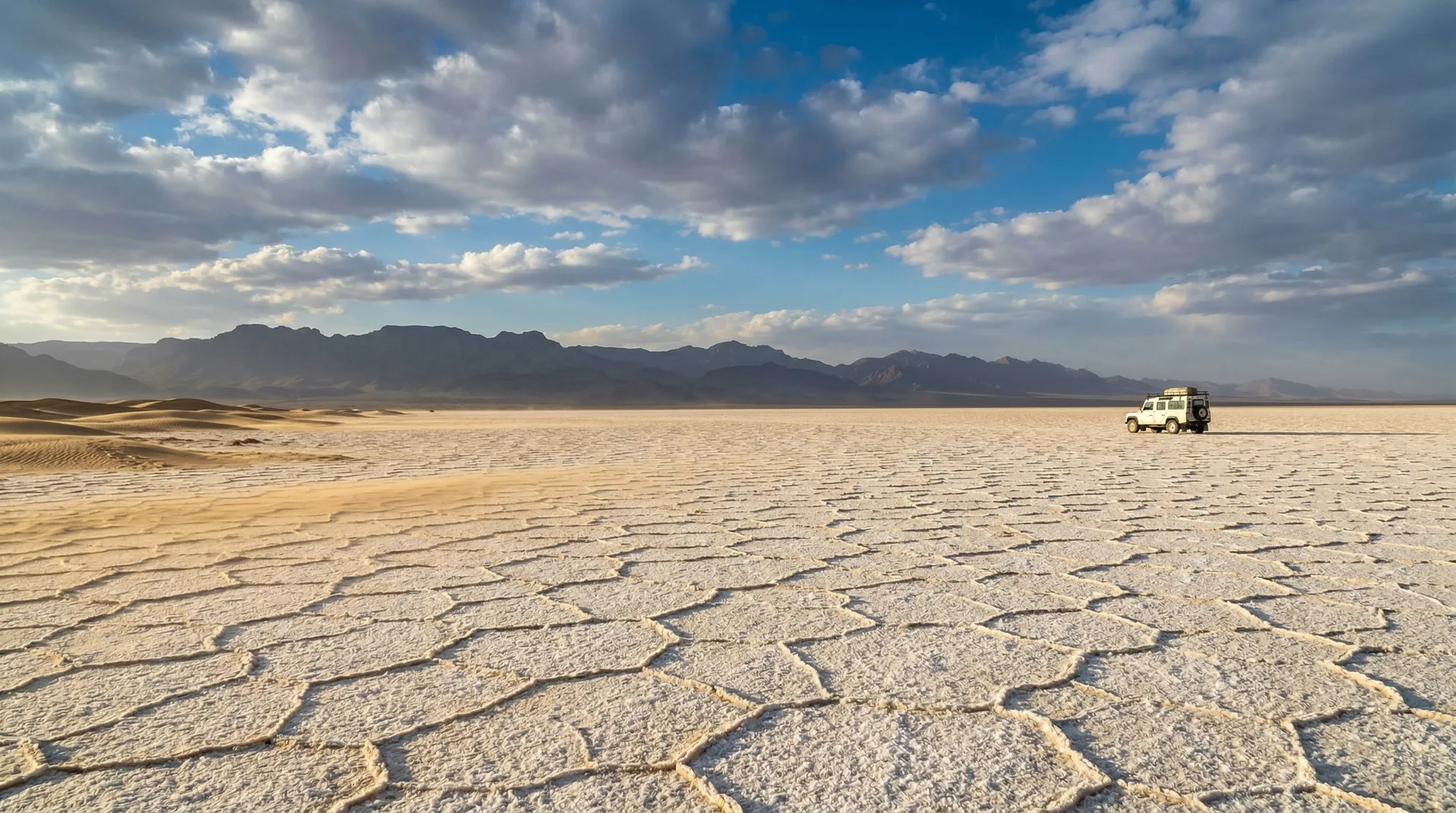
M'Hamid El Ghizlane: The Last Oasis & Gateway to Erg Chigaga
At the far end of the Draa Valley, beyond Zagora and roughly a couple of hours' drive on, lies M'Hamid El Ghizlane — the last village before the open Sahara and the traditional jumping-off point for the great dune sea of Erg Chigaga. Often called simply M'Hamid, it sits where the tarmac runs out and the desert begins, a quiet oasis settlement of palm groves, old ksour and a small Saturday souk that was once a caravan stop on the long trans-Saharan trade routes. Most travellers come here to load into a 4x4 or onto a camel and head out across the hammada and dunes to the remote camps of Erg Chigaga, the wilder, less-developed alternative to Merzouga's Erg Chebbi. This guide covers M'Hamid as a desert gateway: the oasis and its ksour, the route out to Erg Chigaga, the famous desert music festival, how to get there, and who it suits.
M'Hamid as the end of the road and gateway to Erg Chigaga
M'Hamid's main role is its position: it is the last village at the southern end of the Draa Valley, the point where the sealed road effectively ends and the open desert takes over. From here travellers transfer into 4x4 vehicles, or set out by camel, for the journey across stony desert and dunes to Erg Chigaga, a large and remote sand sea. Because of this, M'Hamid functions less as a sightseeing destination in itself and more as the staging post where Sahara trips into the deep desert are organised and begin.
02Desert
The route out to Erg Chigaga
Erg Chigaga is reached from M'Hamid by a rough off-road crossing — commonly cited as something in the region of a couple of hours by 4x4 over hammada (stony desert) and sand, though times vary with conditions and route, so confirm locally. It is more remote and far less developed than Merzouga's Erg Chebbi, with fewer camps and little infrastructure, which is much of its appeal for travellers wanting a wilder, quieter desert. The dunes themselves are extensive; reaching them is part of the adventure rather than a quick hop from a paved road.
03The oasis
The M'Hamid oasis and palm groves
M'Hamid sits in an oasis of date palms fed by the Draa, the long river that runs down the valley and finally peters out toward the desert. The palmeraie shades gardens and small plots and gives the village its green fringe against the surrounding dry, stony land. Walking through the palm groves and irrigated gardens is a quiet pleasure and a reminder of how oasis life clings to the last of the river's water before the Sahara takes over.
04Heritage
Old ksour and the historic Ksar of M'Hamid
Around M'Hamid stand old ksour — fortified earthen villages built of rammed earth and mud-brick — including the historic old quarter sometimes known as the Ksar of M'Hamid (Ksar Ouled Driss is among the names associated with the area's ksour). Some are partly ruined and others still lived in, reflecting the desert-edge building tradition of southern Morocco. A few have small museums or collections of everyday desert objects; exploring them gives a sense of how this settlement guarded the threshold between the valley and the open Sahara.
05Heritage
A historic caravan stop on the trans-Saharan routes
Like other towns of the Draa, M'Hamid lay on the old trans-Saharan trade routes that once linked Morocco with West Africa, carrying salt, dates, goods and travellers across the desert. Its full name, M'Hamid El Ghizlane — often translated as 'plain of the gazelles' — and its position at the desert's edge speak to a long history as a frontier oasis and caravan halt. That heritage is part of why it remains the natural launch point for journeys deep into the sand.
06The village
The Saturday souk and village life
M'Hamid holds a weekly market — traditionally on Saturdays, though it is worth checking locally before relying on a specific day — when people come in from the surrounding oasis and desert to trade dates, produce and everyday goods. The village itself is small and unhurried, with the practical cafés and shops you would expect of a remote oasis settlement. It is a working community at the end of the valley rather than a polished tourist town, which is part of its quiet character.
07Activities
Camel trekking from the desert's edge
M'Hamid is a classic starting point for camel treks into the desert, from short rides out to nearby dunes to multi-day caravans toward Erg Chigaga and the smaller Erg Lehoudi closer to the village. Travelling by camel at the pace of the old caravans, camping among the dunes, is one of the most evocative ways to experience this stretch of Sahara. Such treks are arranged locally through camps and guides; longer crossings call for proper preparation and a reliable operator.
08Desert
Erg Lehoudi and dunes near the village
Closer to M'Hamid than the great Erg Chigaga lies Erg Lehoudi, a smaller, more accessible patch of dunes sometimes used for shorter trips and overnight camps when time is limited. It offers an easier taste of dune scenery without the long off-road haul out to Chigaga, though it is more visited and less pristine as a result. Think of it as a convenient nearby option, with Erg Chigaga the deeper, wilder goal for those with more time.
09Activities
Desert camps under the stars
Out in the dunes beyond M'Hamid, tented desert camps offer overnight stays with dinner, music around the fire and dark, clear night skies far from any town lights. Camps range from simple bivouacs to more comfortable set-ups, and because Erg Chigaga is remote and lightly developed, nights there feel genuinely off-grid. The combination of silence, sand and stars is the main reason travellers make the effort to come this far down the valley.
10Culture
The desert music festival at M'Hamid
M'Hamid is known for a desert music festival — most associated with the village is the Taragalte Festival, a gathering that celebrates Saharan nomadic and trans-Saharan culture with music, crafts and exchange, generally held in the cooler season. Dates and programmes change from year to year and from one event to another, so check the current schedule before planning a trip around it. When it runs, it brings a burst of music and visitors to this quiet oasis at the desert's edge.
11Getting here
Getting to M'Hamid
M'Hamid is reached by road down the Draa Valley, continuing on from Zagora to the southern end of the valley — commonly cited as roughly a couple of hours beyond Zagora, conditions permitting. From Marrakech the full journey crosses the High Atlas over the Tizi n'Tichka, passes Ouarzazate and follows the Draa south through Zagora, so it is usually approached as part of a longer southern circuit. There is no major airport here; nearly everyone arrives overland, with Ouarzazate the nearest larger hub on the way.
12Planning
Who M'Hamid suits — and the honest reality
M'Hamid suits travellers drawn to a wilder, quieter Sahara who don't mind a rough 4x4 transfer and minimal infrastructure in exchange for remoteness — it is the gateway to Erg Chigaga's deep, lightly visited dunes. Be honest about the trade-offs: it is far down the Draa Valley, the deep desert needs a long off-road crossing, and facilities are basic compared with the busier Merzouga side. If you want big dunes with easier access, Merzouga's Erg Chebbi may suit better; if you want the end-of-the-road, off-grid desert, M'Hamid is the launch point.
Frequently asked
Where is M'Hamid El Ghizlane and why go there?
M'Hamid El Ghizlane sits at the far southern end of the Draa Valley, beyond Zagora, where the tarmac runs out and the Sahara begins. It is the last oasis village before the open desert and the traditional gateway to Erg Chigaga, a large, remote dune sea. Travellers go there to launch 4x4 trips and camel treks into the deep desert, to camp among the dunes, and to experience a quieter, wilder Sahara than the busier Merzouga side.
How do you get from M'Hamid to Erg Chigaga?
Erg Chigaga is reached from M'Hamid by a rough off-road journey across stony desert and sand, often cited as something around a couple of hours by 4x4, though times vary with route and conditions — confirm locally. There is no sealed road out to the erg; the crossing itself is part of the experience. Some travellers also approach by camel over one or more days. Either way it is more remote and less developed than reaching Merzouga's Erg Chebbi.
Is M'Hamid better than Merzouga for the desert?
It depends on what you want. M'Hamid and Erg Chigaga are wilder, quieter and more remote, with fewer camps and a longer off-road approach — appealing if you want an off-grid desert and don't mind basic facilities and a rough transfer. Merzouga's Erg Chebbi is larger in places, more developed and easier to reach, with more camps and infrastructure. M'Hamid suits travellers chasing remoteness; Merzouga suits those wanting big dunes with easier access.
Is there a music festival at M'Hamid?
Yes — M'Hamid is associated with a desert music festival, most notably the Taragalte Festival, which celebrates Saharan nomadic and trans-Saharan culture with music and crafts, generally in the cooler season. Programmes and dates change year to year, so check the current schedule before planning around it. When it runs, it brings music and visitors to the otherwise quiet oasis at the edge of the desert.
See it with a local
Turn this into a private Sahara trip.
We'll build a private, guided plan around the experiences you care about — with a driver, hand-picked riads and a written quote. We confirm by email within 24 hours.