The Dadès Gorge: Switchbacks, Kasbahs and the Valley of Roses
Carved by the Oued Dadès as it tumbles out of the High Atlas, the Dadès Gorge is one of the great set-pieces on the Road of a Thousand Kasbahs between Ouarzazate and the desert. The valley is famous for the tight serpentine switchbacks of the road that climbs its upper reaches, for the strange eroded rock formations known locally as the 'monkey fingers', and for the rose-growing villages of the Valley of Roses at its mouth. Mud-brick kasbahs and ksour cling to the riverbanks beneath red-rock walls, and the gorge pairs naturally with the neighbouring Todra on a classic southern road trip. This guide explains what to see along the Dadès, where the best viewpoints are, and how it fits a Marrakech-to-desert route.
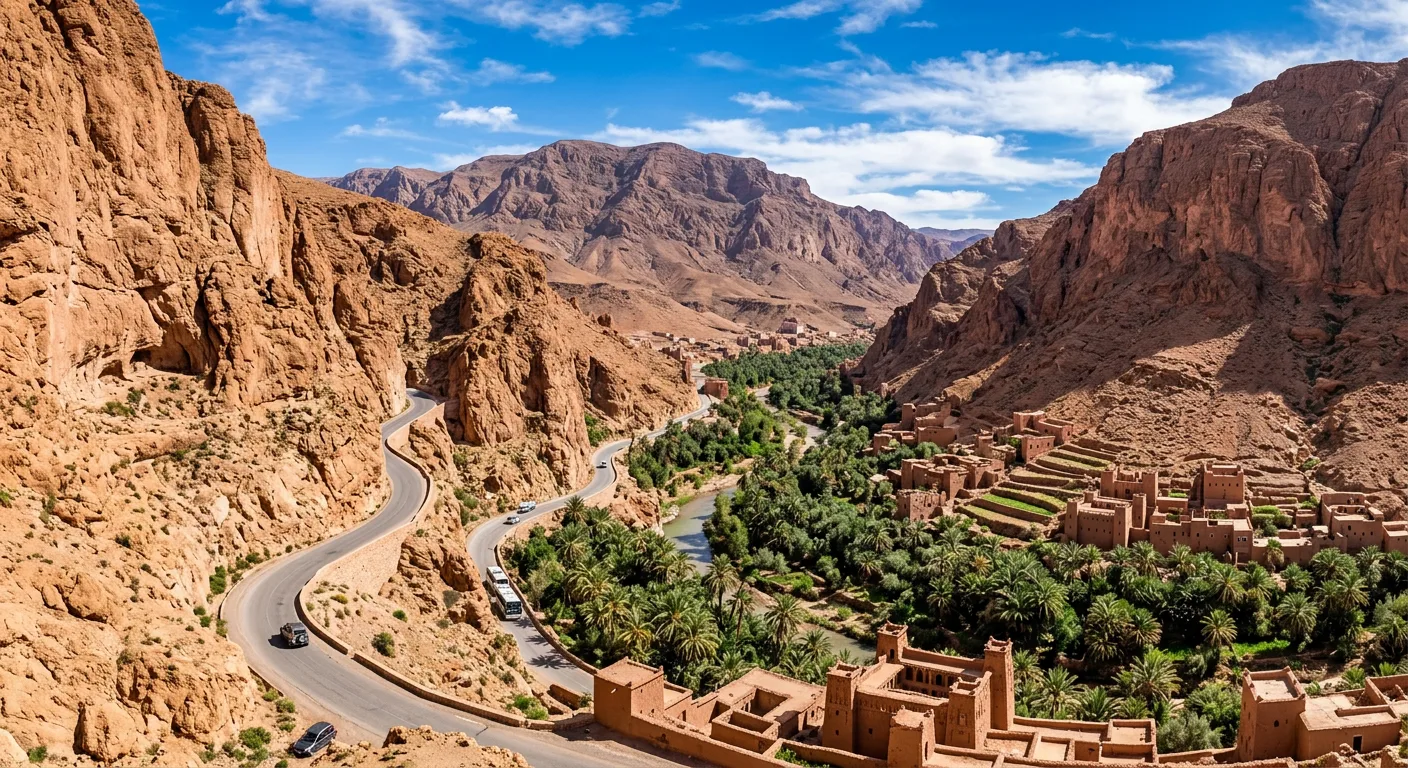
The signature image of the Dadès is the road that hairpins up the valley side in a series of tight, looping switchbacks, doubling back on itself again and again as it climbs out of the gorge. A viewpoint and café above the bends give the classic photograph looking down on the coiling tarmac. Drive it slowly, watch for oncoming vehicles on the narrow turns, and stop only where it is safe to pull off.
02Nature
The 'monkey fingers' rock formations
Along the valley you pass clusters of bulbous, eroded rock pillars that locals nickname the 'monkey fingers' (doigts de singe) for their knuckled, finger-like shapes. Wind and water have weathered the soft rock into these rounded forms, and they are a popular short stop for photos. A few cafés and viewpoints sit nearby, making it an easy pause on the drive up the gorge.
03Culture
Kasbahs and ksour along the river
The Dadès is part of the Road of a Thousand Kasbahs, and fortified earthen kasbahs and ksour line the river where the valley is green enough to farm. Built of rammed earth and mud-brick, many are crumbling while others are still lived in or restored as guesthouses. They are best seen in low morning or evening light, when the red walls glow against the cliffs behind them.
04Culture
The Valley of Roses and Kelâat M'Gouna
At the mouth of the gorge lies the Valley of Roses, centred on the town of Kelâat M'Gouna, where hedgerows of Damask roses are grown for rose water and rose oil. The blooms are harvested in spring, and the area is dotted with distilleries and shops selling rose products. It is one of the most distinctive stops on the southern route and the source of the region's famous rose festival.
05Culture
The Rose Festival (Moussem of Roses)
Kelâat M'Gouna holds an annual rose festival, usually around May to coincide with the harvest, with music, processions and stalls of rose water, soap and oil. The exact dates shift from year to year and are tied to the bloom, so check the current year's timing before planning around it. If you do coincide with it, the valley is at its most festive and fragrant.
06Hiking
Walks and treks from the gorge floor
Trails lead off the valley into the surrounding hills and side canyons, ranging from short strolls between villages and gardens to longer guided half-day walks. The gorge is also a staging point for treks into the M'Goun massif of the central High Atlas, one of Morocco's high mountain areas. For anything beyond a gentle valley walk, go with a local guide who knows the routes and conditions.
07Nature
Viewpoints over the valley
Several terraces, cafés and pull-offs along the road frame the gorge from above, looking down on the green ribbon of cultivation, the river and the red-rock walls. The most famous overlooks the switchbacks, but quieter spots line the climb. Soft morning and late-afternoon light is kindest to the layered cliffs and the patchwork of gardens on the valley floor.
08How to visit
Staying overnight in the gorge
Many travellers break the journey with a night in the Dadès rather than rushing through, basing themselves in a guesthouse or auberge on the valley floor. An overnight lets you catch the gorge in early and late light, walk in the cool of the day, and enjoy the quiet once the day-trip traffic has passed. It also breaks up the long drive between Ouarzazate and the desert comfortably.
09Scenic drive
The Road of a Thousand Kasbahs
The Dadès sits on the celebrated Road of a Thousand Kasbahs, the route strung with fortified earthen towns running east from Ouarzazate. Approaching from the west you pass the palm oasis of Skoura with its well-known kasbahs before reaching Boumalne Dadès at the gorge mouth. The drive itself is a highlight, threading oases, ksour and dramatic desert horizons.
10Day trip
Pairing the Dadès with the Todra Gorge
The Dadès and the neighbouring Todra are the twin gorges of the region and pair naturally on a road trip, linked by scenic back roads over the intervening hills as well as the main valley route. A common pattern is a night in one gorge and a visit to the other, combining the Dadès switchbacks and roses with the soaring narrows and palmeraie of the Todra near Tinghir.
11How to visit
Boumalne Dadès, the gateway town
Boumalne Dadès sits where the gorge meets the main road and serves as the practical gateway, a place to refuel, stock up and turn north into the valley. It is a working town rather than a sight in itself, but it is the natural jumping-off point for the drive up the gorge and a useful base for exploring the Valley of Roses and the road on to Tinghir.
Frequently asked
Where is the Dadès Gorge?
The Dadès Gorge lies in southern Morocco on the Road of a Thousand Kasbahs, where the Oued Dadès cuts down out of the High Atlas. It runs north from the town of Boumalne Dadès, sitting roughly between Ouarzazate to the west and the Todra Gorge near Tinghir to the east, and is usually visited as part of a road trip between Marrakech and the desert.
What is the Dadès Gorge famous for?
It is best known for the dramatic serpentine switchbacks of the road climbing the upper gorge, the eroded 'monkey fingers' rock formations, and the kasbahs and ksour that line the river. At its mouth lies the Valley of Roses around Kelâat M'Gouna, where Damask roses are grown for rose water and oil and celebrated each spring at the rose festival.
How does the Dadès pair with the Todra Gorge?
The Dadès and the Todra are the twin gorges of the region and are commonly combined on the same trip, linked by the main valley road and scenic back routes over the hills between them. A typical pattern is to overnight in one gorge and visit the other, pairing the Dadès switchbacks and roses with the soaring narrows and palmeraie of the Todra near Tinghir.
When is the Valley of Roses festival?
Kelâat M'Gouna holds an annual rose festival, generally around May to coincide with the rose harvest, with music, processions and stalls of rose products. The exact dates shift from year to year and depend on the bloom, so check the current year's timing locally or with your trip organiser before planning around it.
See it with a local
Turn this into a private Dadès Gorge trip.
We'll build a private, guided plan around the experiences you care about — with a driver, hand-picked riads and a written quote. We confirm by email within 24 hours.