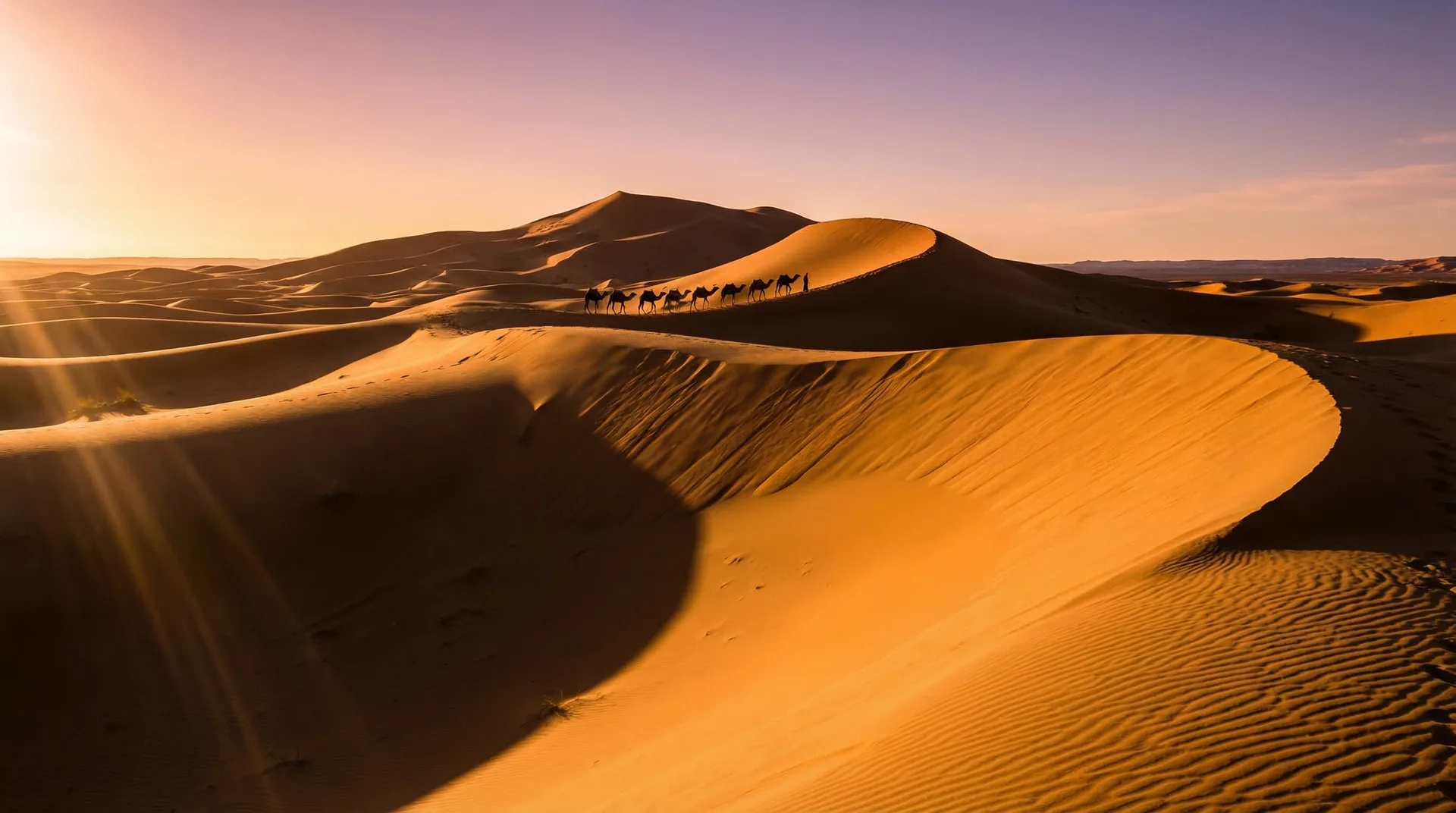
A night in the Sahara is one of the best things you can do in Morocco — but it rewards a little expectation-setting. None of what follows is meant to put you off; it's the honest briefing we'd give a friend before they went, so the surprises are the good kind. Read it, pack accordingly, and the desert delivers.
It's a long drive — treat it as part of the trip
The single thing most people underestimate is the distance. The big dunes of Erg Chebbi, near Merzouga, sit roughly eight to ten hours by road from Marrakech, and around seven hours from Fes. That's not a detour — it's a full day's drive across the High Atlas and down through the south.
The good news is that the road is genuinely spectacular: the Tizi n'Tichka pass, Aït Ben Haddou, the Dadès and Todra gorges, oases and kasbahs strung along the way. So the journey is part of the experience, not a chore. The honest warning: a rushed single overnight that races down and straight back is exhausting, and you'll see the dunes through a fog of tiredness. If you possibly can, break the journey over two or three days so the desert is a destination you arrive at, not a finish line you sprint to.
Pack for big temperature swings
Deserts run hot by day and cold by night, and the gap is wider than people expect. Even in spring and autumn, when the afternoon feels warm or even hot, the temperature can drop sharply once the sun goes down and the night can feel genuinely cold. Bring layers and a proper warm top to pull on after dinner — you'll be glad of it under the stars, and again at the pre-dawn start for sunrise.
Summer is the other extreme: midday heat in the dunes is fierce and not to be taken lightly, which is why many travellers shift their desert time to the cooler edges of the day. Whatever the season, pack for both ends of the swing rather than for the weather you set off in.
Sun and sand: a hat, sunscreen and a scarf
Sun protection out here isn't a nicety. A wide-brimmed hat, high-factor sunscreen and sunglasses are the baseline. The most useful single item is a long cotton scarf — the cheche many travellers pick up locally — which does double duty: it shades your face and neck, and it pulls up over your mouth and nose when the wind kicks up blowing sand. Light, loose, covering clothing tends to beat bare skin in the dunes.
Limited signal, few ATMs — carry cash
Expect to go off-grid. Mobile signal near the dunes is patchy to non-existent, and many camps run on solar with limited power — so treat a desert night as a welcome break from your phone rather than a place to depend on it. Just as importantly, ATMs are scarce once you leave the bigger towns, so draw out enough cash before you head into the deep south. You'll want it for tips, drinks and small purchases in places where cards simply aren't taken.
The camel ride — short, and not always comfortable
The camel trek into the dunes is the postcard image, and it's worth doing — but set expectations. Rides are usually short, heading out for sunset or back at sunrise, and they can feel awkward or uncomfortable, especially the lurch as the camel stands up and lies down. If you have back or hip trouble, or simply don't fancy the saddle, a 4x4 transfer into camp is almost always an option and reaches the same dunes. Neither choice is wrong.
Choose a camp that's run well — and respect the people
Camps vary enormously, so it's worth choosing a reputable, responsibly-run one rather than simply the cheapest — comfort, food and how an operator treats its staff and the land all differ. Out in the desert you're a guest in nomad and Berber communities: ask before photographing people, tip fairly for genuine service, and remember the place isn't a backdrop. We don't name or rate specific camps here, but it pays to check what a camp actually includes and how it's run before you commit.
A few last honest notes
Wind and the odd sandstorm happen. Most days are still, but the desert can blow up suddenly — another reason that scarf earns its place, and a reason to keep electronics in a sealed bag. Pack light, in a soft bag: soft holdalls travel far better than hard suitcases on camels, in 4x4s and across sand, and you genuinely don't need much for a night or two out.
If you are still choosing a route, start with how to visit the Sahara desert; for the background, see what the Sahara desert is known for.
Still deciding where to go and how long to spend? Our Merzouga vs Zagora comparison weighs the two main gateways, and you can browse our desert tour options here.
Frequently asked
How long is the drive to the Sahara, really?
It's a long way, and that surprises people more than anything else. Merzouga and the big dunes of Erg Chebbi sit roughly eight to ten hours by road from Marrakech, and around seven from Fes. The road itself — over the High Atlas passes, past Aït Ben Haddou, through the Dadès and Todra gorges — is genuinely some of the best scenery in the country, so it's part of the trip rather than a tax on it. But a single rushed overnight that drives there and straight back is a hard, tiring way to do it. If you can, break the journey over two or three days so the desert is a destination, not a sprint.
Does it get cold in the desert at night?
Yes — genuinely cold, and this catches people out. Even in spring and autumn, when the days are warm, the temperature drops sharply once the sun goes down, and desert nights can feel surprisingly raw. Bring layers and a warm top you can put on after dinner, even if the afternoon felt like t-shirt weather. Summer is the opposite problem: midday heat in the dunes is extreme and not to be underestimated. Pack for both ends of the swing rather than the temperature you arrived in.
What should I take for sun and sand?
Sun protection isn't optional out here. A wide-brimmed hat, high-factor sunscreen and sunglasses are the basics. A long cotton scarf — the cheche many travellers buy locally — earns its keep twice over: it shades your neck and face from the sun, and it pulls up over your mouth and nose when the wind picks up blowing sand. Light, loose, covering clothing tends to beat bare skin in the desert.
Will I have phone signal and access to cash?
Plan for limited connectivity. Mobile signal out near the dunes is patchy to non-existent, and many camps run on solar with restricted power, so treat a night in the desert as a chance to be offline rather than a place to rely on your phone. ATMs are scarce once you leave the larger towns, so draw out enough cash before you head into the deep south — you'll want it for tips, drinks and incidentals where cards aren't accepted.
Is the camel ride comfortable?
Honestly, it's an experience more than a comfort. Camel rides into the dunes are usually short — typically heading out for sunset or back for sunrise — and they can feel awkward or uncomfortable, especially the lurch as the animal stands and sits. If you have back or hip issues, or simply don't fancy it, a 4x4 transfer into camp is almost always available as an alternative and gets you the same dunes without the saddle. Neither is wrong; pick what suits you.
How do I choose a good, responsible camp?
Choose a reputable, responsibly-run camp rather than the cheapest you can find — quality, comfort and how an operator treats both staff and the environment vary a lot. Out in the desert you're a guest in nomad and Berber communities, so a little respect goes a long way: ask before photographing people, tip fairly for genuine service, and don't treat the place as a backdrop. We don't name or rate specific camps here, but it's worth checking what a camp actually includes and how it's run before you book.
Ready for the dunes?
We plan the drive, the camp and the pacing so the desert lands right.
Tell us your dates, your comfort level and how much time you have — Sahara Desert Adventures will build a route that gives the dunes the time they deserve, without the rushed overnight.
Request an itinerary