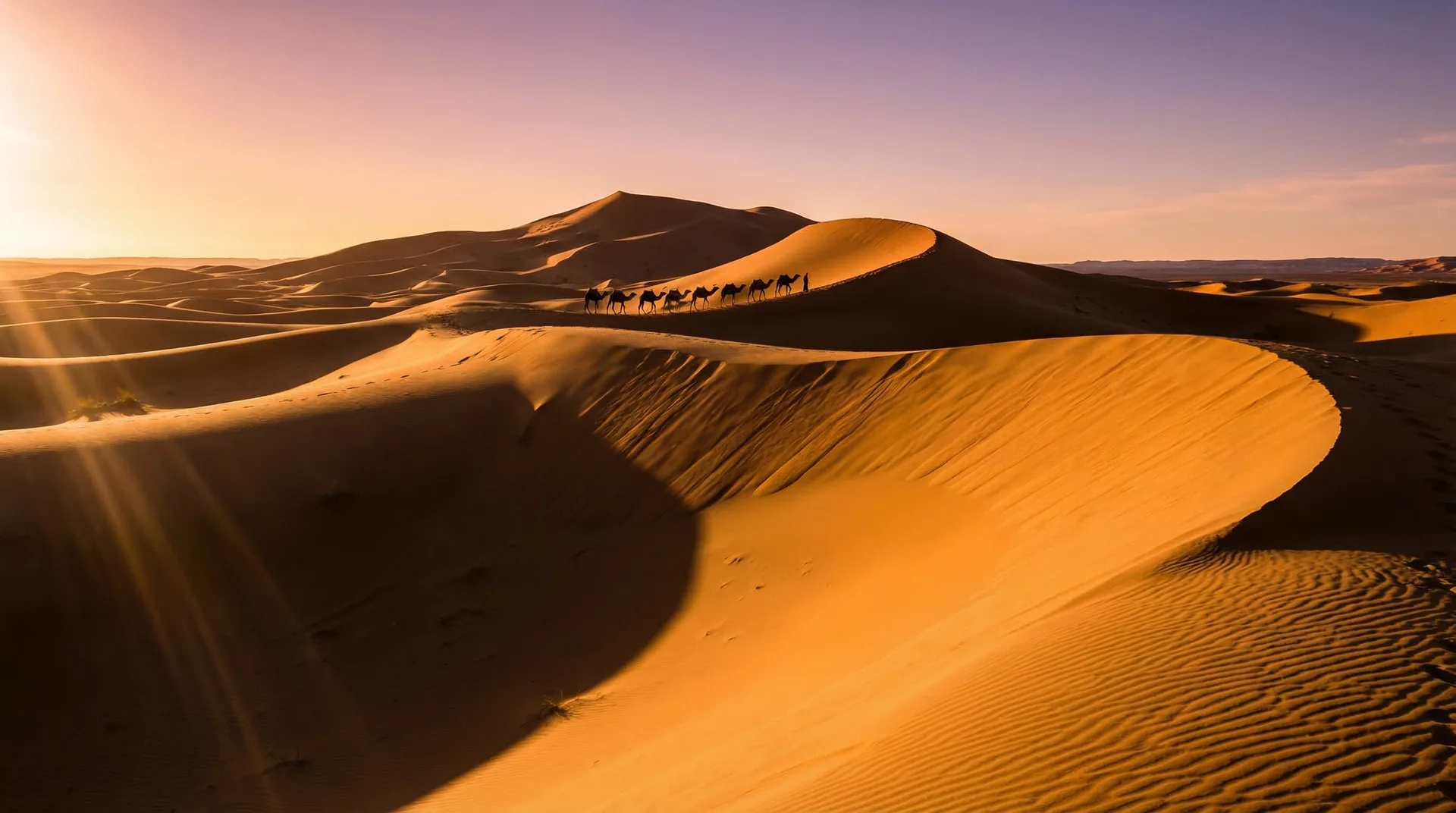
Merzouga Village: The Dune-Edge Base for Erg Chebbi
Merzouga is a small desert village on the western edge of Erg Chebbi, the great sea of sand that rises straight out of the surrounding stony plain. It is the main base for Sahara trips from this side of Morocco — the point where the long road from Marrakech, Fes or Ouarzazate finally meets the dunes. The village itself is a low, spread-out cluster of kasbah-style hotels and auberges, many built right against the sand so you can walk into the dunes from the door, alongside a handful of cafés, shops and fossil and craft sellers. This guide is about Merzouga as a place to stay and set off from: what the village is like, the nearby twin village of Hassi Labied and the seasonal Dayet Srji lake, the activities you launch from here, and how to get to it.
What makes Merzouga special is how close it sits to the sand. Erg Chebbi rises directly from the edge of the village, so many places to stay are built right against the dunes and you can often walk out into them from where you are sleeping. This is the staging point for the whole area: most camel treks, dune excursions and overnight desert camps set off from here or from the sand just behind the village.
02The village
The kasbah-hotel village character
Merzouga is not a single tight medina but a scattered, low-rise settlement strung along the western side of the dunes. Much of the accommodation takes the form of kasbah-style auberges and small hotels built in earth-toned local style, spread out rather than clustered. Between them are a few cafés, small shops and sellers of fossils and crafts. It is a quiet, functional desert village whose life is shaped by the dunes and by visitors heading into them.
03The village
Walking into the dunes from your door
Because the sand begins at the edge of the village, you do not always need a vehicle or a long trek to reach the dunes. From many places to stay you can step out and walk up the nearest crests on foot, which is an easy way to catch sunrise or sunset, or simply to feel the scale of Erg Chebbi. Take water, watch your footing on soft slopes, and keep track of your route, as the dunes look similar in every direction.
04Nearby
Hassi Labied, the neighbouring village
Just north of Merzouga lies Hassi Labied, a small neighbouring village also set right against the western edge of Erg Chebbi. It shares the same dune-edge setting and has its own cluster of auberges and guesthouses, and the two places effectively blend into one strip of accommodation along the sand. Many travellers stay in one or the other without much difference in the experience, since both sit on the same edge of the great erg.
05Nearby
Dayet Srji, the seasonal lake
West of Merzouga lies Dayet Srji, a shallow seasonal lake that fills after winter and spring rains and dries out for much of the year. When it holds water it can attract migratory birds, including flamingos, making it a draw for birdwatchers. Because it depends entirely on rainfall, the lake is often dry, so treat any flamingo sighting as a seasonal bonus rather than a certainty and ask locally about current conditions.
06Activities
Camel treks and overnight desert camps
The signature experience launched from Merzouga is a camel trek into Erg Chebbi, often timed for sunset or sunrise and frequently combined with a night in a tented desert camp among the dunes. Camps range from simple Berber bivouacs to more comfortable setups, and a typical overnight includes dinner, music around the fire and breakfast at dawn. These trips set off from the village or the sand just behind it, usually arranged through your accommodation.
07Activities
4x4 dune trips, sandboarding and quad biking
Beyond camels, Merzouga is the launch point for a range of dune activities. Guided 4x4 excursions cross the plains and skirt the sand to reach outlying sights; sandboarding uses the steep dune faces near the village; and quad biking and buggy tours run across the flats and dune edges. All of these are typically organised locally through auberges and guides, who set the routes and provide the equipment.
08Culture
Gnaoua heritage at nearby Khamlia
A few kilometres south of Merzouga is the village of Khamlia, known for its Gnaoua music — spiritual, trance-like rhythms played on metal castanets, a bass lute and drums by a community with sub-Saharan roots tied to the old trans-Saharan trade routes. Visitors are commonly welcomed for a short performance and mint tea. It makes an easy and meaningful add-on to a stay in Merzouga, best arranged through your camp or guide.
09The village
Cafés, fossil and craft sellers in the village
Day to day, Merzouga offers a modest scattering of cafés and small shops where you can pause between excursions, along with sellers of fossils and crafts that reflect the wider region's trade in polished ammonite-bearing stone and Berber goods. It is a low-key place rather than a shopping destination, so keep expectations simple: the village exists mainly as a base for the dunes, with just enough services to support a comfortable stay.
10Getting here
Getting to Merzouga: the long drive to the dunes
Merzouga is remote, and reaching it usually means a long road journey. It is most often approached from Fes, Marrakech or Ouarzazate, and the drive from Fes or Marrakech commonly takes the best part of two days, frequently broken with an overnight stop along the way. The nearest airport is at Errachidia, roughly a couple of hours away by car. Whichever route you take, the road eventually meets the dunes at the village, where the tarmac gives way to sand.
11Planning
How long to stay and who it suits
One night and two days is generally enough for the core experience — a camel trek and an overnight camp in Erg Chebbi — while two or three days leaves room for Khamlia, Hassi Labied, Dayet Srji and slower time on the dunes. Merzouga suits travellers who want to reach a genuine sand-dune desert and are willing to make the long journey for it; those short on time may prefer a closer desert option, but for the classic Erg Chebbi experience this is the place to base yourself.
Frequently asked
What is Merzouga village actually like?
Merzouga is a small, spread-out desert village on the western edge of the Erg Chebbi dunes. Rather than a tight medina, it is a low strip of kasbah-style auberges and small hotels built along the sand, with a handful of cafés, shops and fossil and craft sellers. Many places to stay sit right against the dunes, so you can often walk into the sand from the door. It is a quiet base whose life revolves around the desert and the activities people set off to do.
How do you get to Merzouga?
Merzouga is usually reached by road from Fes, Marrakech or Ouarzazate. The drive from Fes or Marrakech commonly takes the best part of two days and is often broken with an overnight stop, while the nearest airport is at Errachidia, roughly a couple of hours away by car. It is a remote destination, so most visitors plan the long journey as part of the trip rather than expecting a quick hop to the dunes.
What is there to do in and around Merzouga?
Merzouga is the base for the area's desert activities. From here you can take a camel trek into Erg Chebbi and stay overnight in a tented desert camp, try sandboarding on the dunes, join a 4x4 dune trip or go quad biking. Nearby you can visit Khamlia for Gnaoua music, the neighbouring village of Hassi Labied, and the seasonal Dayet Srji lake, which can attract flamingos when it holds water after rains.
How many days should you spend in Merzouga?
One night and two days is usually enough for the classic experience of a camel trek and an overnight desert camp in Erg Chebbi. Two or three days gives more room to add nearby sights such as Khamlia, Hassi Labied and Dayet Srji, and to spend slower time on the dunes. Given the long drive to reach the village, many travellers feel an overnight stay near the dunes is worth building into the trip.
See it with a local
Turn this into a private Sahara trip.
We'll build a private, guided plan around the experiences you care about — with a driver, hand-picked riads and a written quote. We confirm by email within 24 hours.