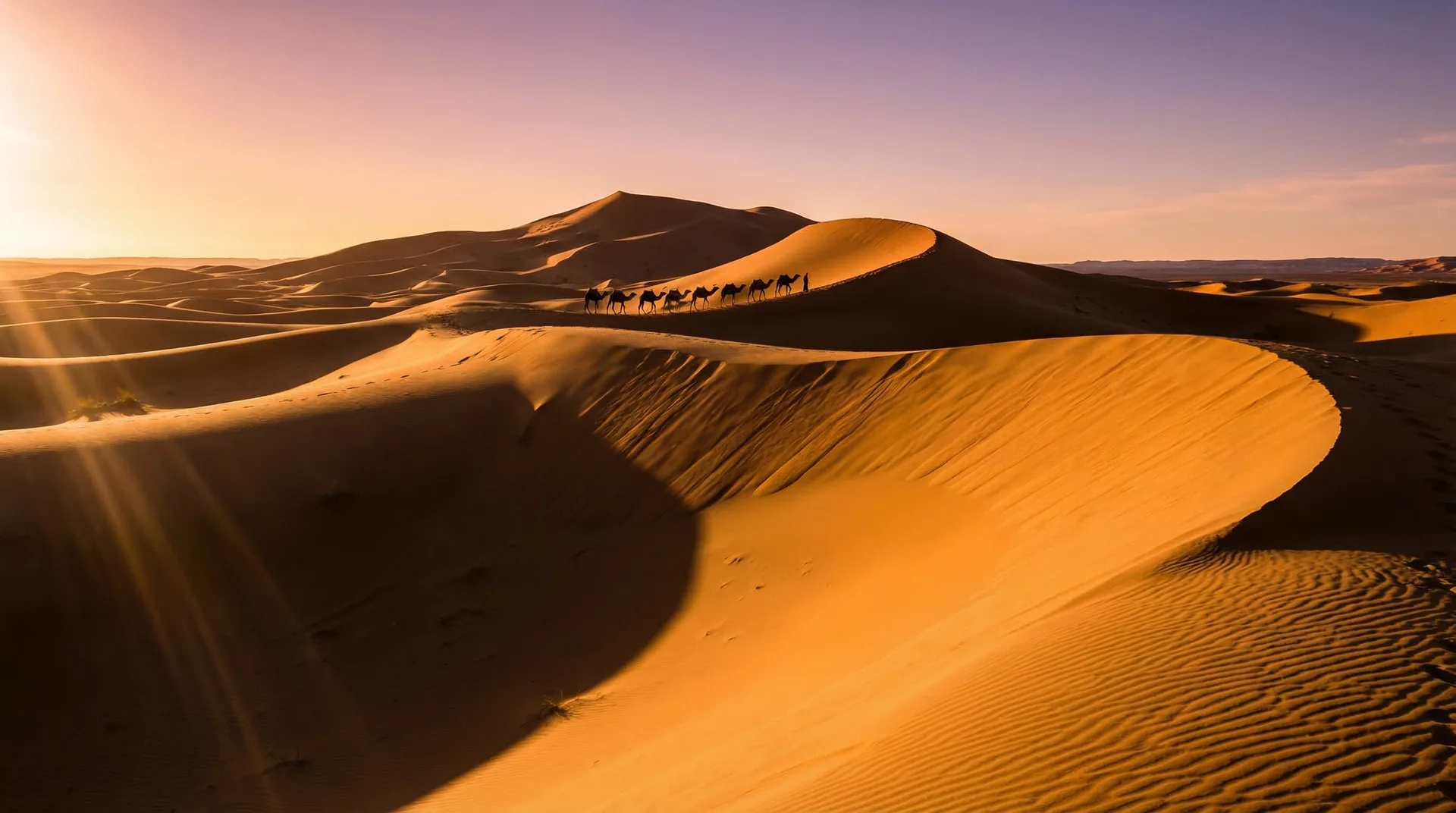
Seven days is the sweet spot for a first run to the Sahara — long enough to earn the dunes properly, short enough to avoid the fatigue of trying to see everything. The classic loop below is one we've refined over hundreds of private desert journeys: it builds steadily from Marrakech through mountain passes and kasbah valleys to the Erg Chebbi dunes, then returns north to Fès, without a single wasted hour.
Day 1 — Arrive in Marrakech: settle in before the desert
Most flights arrive in the afternoon. Resist the urge to plunge into the medina immediately — jet lag and sensory overload are a bad combination, and you have a long southbound drive ahead. Let your riad receive you: a glass of mint tea, a roof terrace at sunset, dinner in the courtyard. This first evening sets the tempo for the desert run. Your desert driver-guide will park outside and walk you through the alley to the door — part of the arrival ritual.
Day 2 — Marrakech: the medina, and kit for the dunes
Start early, before the heat builds and the Djemaa el-Fna fills with smoke. The souks by 9 am are a different animal: traders arranging their stalls, light falling through the reed ceiling, no pressure to buy. This is the morning to pick up a chèche scarf for the desert and a sun hat. The Ben Youssef Medersa rewards a slow visit — give it an hour. Lunch inside the medina: a small Berber café, not the tourist restaurants circling the main square. The afternoon is yours: the Mellah's silver jewellers, the tanneries of the northern quarter, or — honestly — a hammam and a rest before the road south.
Day 3 — Over the Tizi n'Tichka to Aït Ben Haddou and Ouarzazate
Leave Marrakech by 8 am to catch the pass before midday heat — this is the day the landscape begins turning desert. The Tizi n'Tichka (2,260 m) is Morocco's highest paved road and one of its most dramatic: red rock faces, Berber villages clinging to ledges, argan trees giving way to bare scree. Stop at Aït Ben Haddou for lunch and an hour's walk through the ksar — the light at noon is stark and photogenic. Continue to Ouarzazate, the gateway to the south and Morocco's film-studio capital, for the night. Dinner at a rooftop restaurant overlooking the kasbah walls, with the pre-Saharan plain stretching east.
Day 4 — The Road of a Thousand Kasbahs to Dades Gorge
The N10 east of Ouarzazate is one of Africa's great road-trip routes and your true approach to the Sahara. Stop at Skoura to walk the palmery and visit Kasbah Amerhidil. The kasbahs multiply as the road deepens into the pre-Saharan plain — Kelaa M'Gouna in rose season (April–May) smells extraordinary. Arrive in Dades Gorge by late afternoon: the canyon turns blood-red at dusk. Stay in a small lodge above the gorge floor with views up the valley. Dinner is simple and excellent — tagine, salad, home-pressed argan oil — and the desert feels close now.
Day 5 — Todra Canyon and into the Erg Chebbi dunes
An early drive north from Dades brings you to the Todra Gorge by 9 am — a slot canyon with 300-metre walls that narrows to eight metres at its tightest. The light is at its best in the morning. Walk the canyon floor (30 minutes) before the tour buses arrive. Then south and east across the hammada — the Sahara's stony reg — to Merzouga, where the Erg Chebbi dunes rise abruptly out of the flat earth, some cresting 150 metres. Meet your camels mid-afternoon and ride the caravan over the ridgelines into camp, arriving as the sand turns copper at sunset. The camel trek is the classic way in; a 4x4 transfer is there if you prefer. The camp dinner beneath a sky with no light pollution — the Milky Way stretched corner to corner — is the reason you came.
Day 6 — Sahara sunrise, then the long road north to Fès
Wake before dawn — 5:30 am feels brutal until you climb a dune barefoot and watch Erg Chebbi turn amber, the camp falling silent behind you. Coffee in camp, a last look back at the dunes, then transfer to your vehicle and begin the long northward drive: Erfoud, Rich, through the Middle Atlas cedar forests, arriving in Fès in the early evening. The drive is around five to six hours with stops; it's a travel day, but the scenery through Azrou and Ifrane is worth keeping your eyes open. Check into your riad in the Fès el-Bali medina — the largest car-free urban area in the world — before dinner in a Fassi restaurant.
Day 7 — Fès el-Bali: the tanneries, medersa and farewell
Fès rewards an unhurried final day. The Bou Inania Medersa is among the finest examples of Moroccan stucco and zellige work anywhere in the country. The Chouara tanneries are best seen from the leather-shop terraces above — go before 11 am when the vats are active. The Andalusian quarter across the river is quieter and almost untouristed. Lunch at a neighbourhood restaurant, then transfer to the airport for your evening flight. Seven days, two imperial cities and one unforgettable night in the Sahara.
Frequently asked
Is seven days enough to reach the Sahara and back?
Seven days is enough for a deeply satisfying desert-focused loop if you keep it tight: Marrakech, the High Atlas, Aït Ben Haddou, Dades Gorge, the Erg Chebbi dunes at Merzouga, and Fès. The Sahara is the centrepiece — camel trekking and a night of camp stargazing — with the imperial cities as bookends. Trying to add the north (Chefchaouen, Tangier) on the same trip leaves no room for the desert to breathe.
What is the best time of year for a 7-day Sahara itinerary?
March–May and September–November give the best balance of comfortable city temperatures and bearable desert heat, with cold, clear Sahara nights perfect for stargazing. Erg Chebbi and the desert valleys can hit 40 °C and beyond in July and August, turning a sunrise camel ride miserable rather than magical. December–February is fine in the cities, the dunes turn genuinely cold after dark, and mountain passes occasionally close.
Should we fly into Marrakech or Casablanca for a desert trip?
For the classic desert loop below, Marrakech in / Fès out (or vice versa) is the cleanest option — you reach Erg Chebbi without doubling back. Both airports have direct connections to most European hubs. Internal Moroccan flights between the two cities take about an hour if you want to start and finish in the same gateway.
How much does a private 7-day Sahara tour cost?
Fully private, with a desert driver-guide, comfortable riad accommodation, a night in a Sahara camp, most meals and all transfers, expect US$2,500–4,500 per person depending on group size and camp category. Larger groups bring the per-person cost down considerably. Sahara Desert Adventures quotes precisely once we understand your preferences.
Can we do this Sahara itinerary independently without a guide?
The tarmac roads are good and most riads speak English, but the final approach to Erg Chebbi crosses open hammada where a local driver matters, and a desert camp must be arranged in advance. A private driver-guide unlocks the dune-side knowledge, handles medina parking, negotiates at the souk and reroutes around closures. For a first Sahara trip, most travellers find it transforms the experience.
What should we pack for a 7-day Sahara trip?
Light layers work year-round: High Atlas mornings are cool even in summer, the desert is scorching by afternoon and surprisingly cold once the sun drops. Comfortable walking shoes plus a pair you don't mind filling with sand. A scarf or chèche covers your head against dune wind and dust and your shoulders in mosques. Bring a small daypack for the camel ride and an overnight bag for camp; leave the rolling luggage in your vehicle.
Ready to plan?
We'll build this itinerary around you.
Every Sahara Desert Adventures journey is private and bespoke — we adapt the pace, the camp and riad category and the detours to suit your group. Reach out and we'll send a tailored desert proposal within 24 hours.