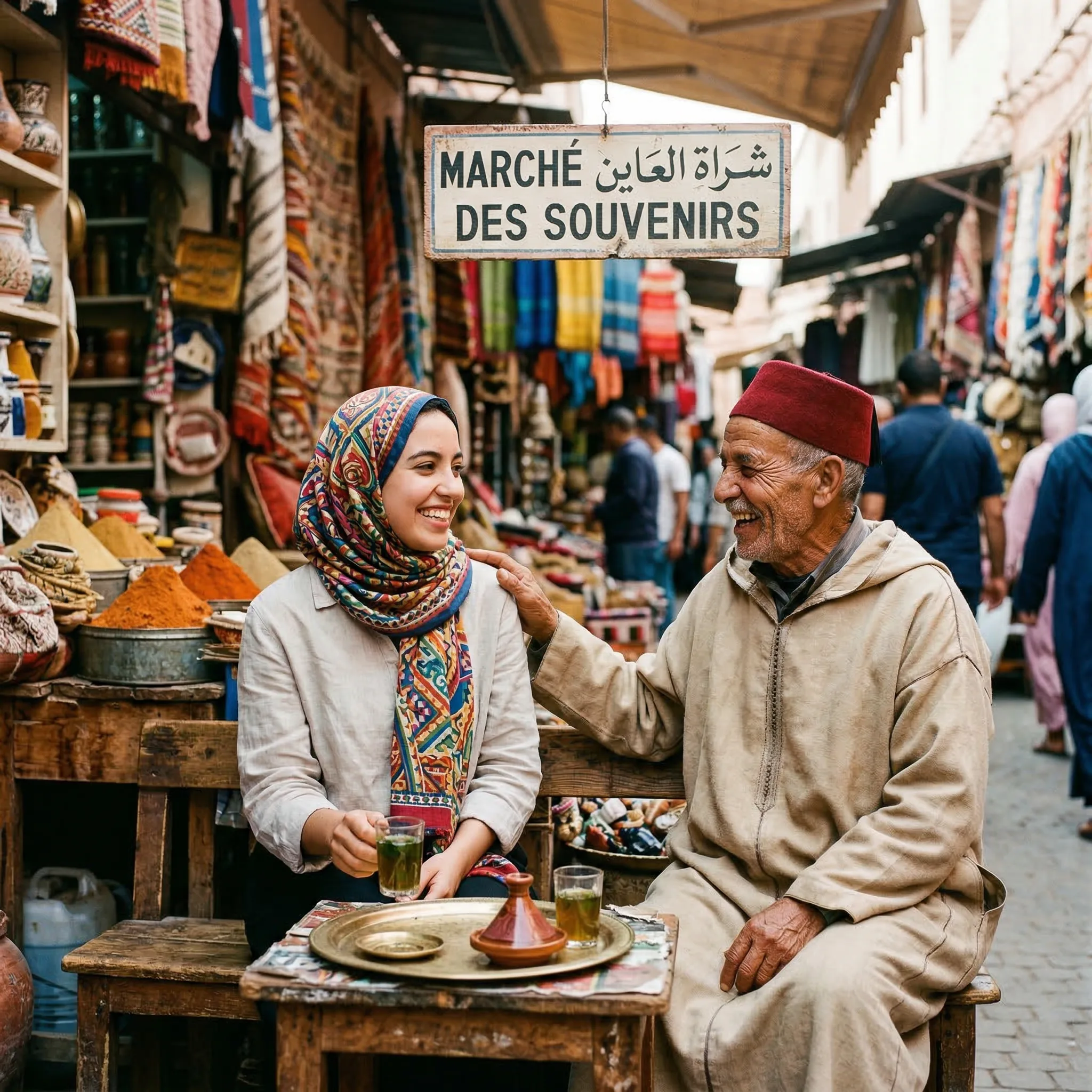
Before any conversation in Morocco, before any negotiation, before any meal — and the moment you swing down off a camel at camp — there is tea. Atay in Darija, the Moroccan Arabic dialect: green gunpowder tea, fresh spearmint, a quantity of sugar that surprises most visitors, poured from a considerable height into a small glass and handed to you with both hands. It is not a drink. It is an act of welcome.
Where did the ritual come from?
Chinese gunpowder green tea reached Morocco through British merchants in the mid-18th century, when Britain was courting North African trade routes. The Sultan preferred it to coffee and took it up with enthusiasm. Within a generation it had replaced older infusions across the country and absorbed the ceremonial weight that traditional hospitality carried — caravan traders carried it deep into the Sahara, where it remains the desert's staple drink. The mint — spearmint, nana — was the Moroccan addition: it grows abundantly in the Atlas foothills and the river valleys around Meknès, the country's mint capital. The marriage of bitter gunpowder tea with cooling mint and sweetening sugar became definitive within decades and has barely changed since.
How is Moroccan mint tea actually brewed?
The process is meticulous and unhurried — deliberately so, and never more so than over a camp brazier as the sky darkens. A little boiling water is first poured over the loose gunpowder leaves in the berrad (the silver or steel teapot), swirled and discarded — this rinse strips bitterness and wakes the leaves. Fresh boiling water goes in, then a generous fistful of spearmint stems packed tight. Sugar — the traditional dose is startling, perhaps four or five teaspoons a pot — follows, and the pot returns to the flame for a short simmer. The host pours a glass, tastes, adjusts, and pours again from 30–40 centimetres up: the fall aerates the tea and raises the prized rim of fine foam. The first three glasses come from one pot, the flavour shifting with each pour as the mint steeps on.
What does 'Berber whisky' mean?
The nickname is affectionate and self-aware. In a country where traditional households do not serve alcohol, mint tea carries the social weight a generous dram of whisky might carry elsewhere: it is offered to guests, it loosens conversation, it signals respect. Call it 'Berber whisky' to a Moroccan host — or to the Berber crew running your desert camp — and you will nearly always get a smile of recognition. The term has run through English travel writing since at least the 1960s, and Moroccans use a version of it in Darija too. It is no slur or jibe — it is a point of pride, a nod to the fact that this ritual is Morocco's own cultural currency.
What is the etiquette for guests?
A few points of etiquette matter. Accept the first glass with both hands or your right hand alone — never the left on its own. Do not rush: the tea is hot and the conversation is the point. Three glasses is the traditional run; refusing the first is impolite, but a warm 'baraka' after the third signals graceful satiation. Complimenting the tea is welcome but unnecessary — the host already knows it is good. In a shop or souk, accepting tea does not commit you to buying anything, whatever the sales pressure suggests; it is a true gesture of welcome and you may leave gracefully after the glass. In a private home — or sitting with the crew around the camp fire — stay for all three rounds: leaving early cuts the hospitality short.
Are there regional variations across Morocco?
Yes, notably. In the Saharan south — Zagora, M'Hamid, Tata, Guelmim, the gateways to Erg Chigaga and the dunes — the Tuareg influence shows: tea comes in three separate rounds, each sweeter and more concentrated than the last. The Tuareg saying attached to it — one glass for health, one for love, one for death — has entered mainstream Moroccan tea culture, though not everyone keeps the formal three-round sequence. In the Rif Mountain towns around Chefchaouen, wormwood (chiba, also called absinthe locally, though unrelated to the European spirit) is sometimes added to the mint for a pleasantly bitter, herbal warmth. Along the Atlantic coast, some households slip orange blossom water into the pot. In Fès, the aristocratic old city and our northern gateway, the ceremony is at its most formal: the tray, the glasses, the pour are all matters of pride. In Marrakech, by contrast, you will drink excellent tea from a plastic cup at a roadside stall for a few dirhams — and out at an Erg Chebbi bivouac, the same brew tastes better still for the silence around it.
Can you recreate it at home?
With a little attention, yes. Chinese gunpowder green tea (in most good tea shops) and fresh spearmint are the two non-negotiables. The pour from height is technique, not showmanship: practise over a sink first. Sugar is a matter of taste, but go too light and you lose the way sweetness balances the bitterness of the gunpowder leaf. A traditional Moroccan teapot — narrow-spouted, heavy steel — is the ideal vessel. Many of our guests bring one home from the Marrakech souk as the most useful souvenir they could have chosen.
Frequently asked
Why is Moroccan mint tea called 'Berber whisky'?
It is a wry local joke. Morocco is largely Muslim and alcohol is uncommon in traditional households, yet mint tea is poured with the same ceremony, warmth and abundance that a generous whisky might be in a Scottish home. The phrase dates to at least the mid-20th century and Moroccans use it affectionately themselves — you'll hear it from camel guides and camp hosts in the deep south.
What type of mint is used in Moroccan tea?
Spearmint — nana in Darija — is the classic variety: bright, cool and faintly sweet. In summer some families add a handful of wormwood (chiba) for a bitter, herbal edge. In the Saharan south, where fresh mint can be scarce, camps sometimes steep desert herbs such as sheeh instead. What you will never find is peppermint, which Moroccans consider too sharp.
How many glasses of tea is it polite to accept?
Three is the traditional number — one for health, one for love, one for death, runs the Tuareg saying that has spread north from the Sahara. Refusing the first glass is considered rude; accepting all three is warm and respectful. After three, a gentle 'baraka' (thank you, I've had enough) is perfectly understood, even around a desert campfire.
Can you ask for tea without sugar in Morocco?
You can ask — 'bla sukkar, afak' (without sugar, please) — and most hosts will try, though traditionalists find the request faintly baffling. To many Moroccans, mint tea without sugar is a handshake with no hand. A fair compromise is 'shwiya sukkar' (a little sugar), which usually buys you a gentler sweetness.
Is there a specific time of day for the tea ritual?
No fixed hour — tea suits any moment. It marks arrivals, sealed deals, a rest after walking, and the end of a meal. In a souk negotiation it often signals an agreement is near; in a desert camp it greets you off the camels and again after dinner under the stars. The ritual is about hospitality, not the clock.
Experience it properly
Tea in a riad courtyard — then again under a Sahara sky.
Every Sahara Desert Adventures itinerary opens with a welcome tea in your riad and closes with one poured fresh at our desert camp. We can also arrange a private tea ceremony with a Berber host, including the history and technique behind the ritual.