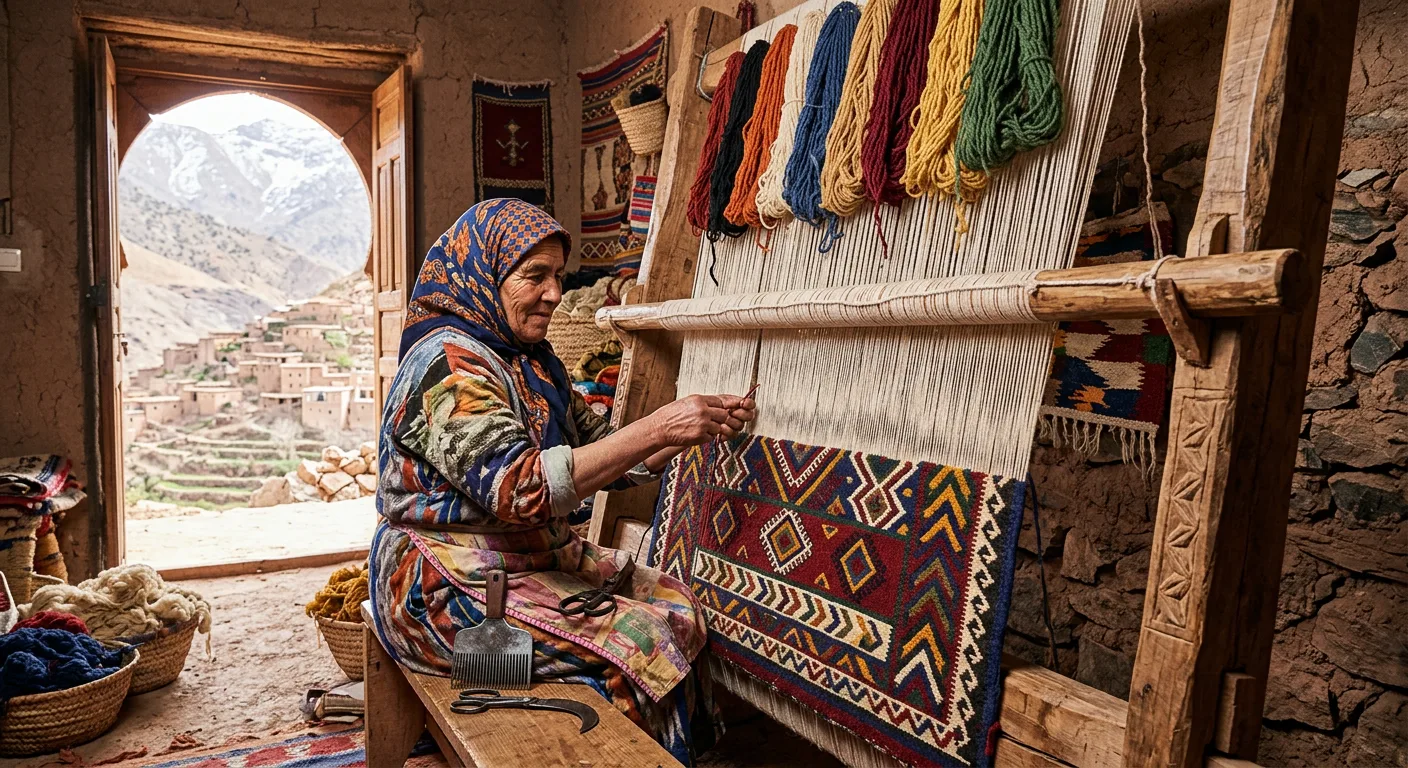
Bargaining in a Moroccan souk is not a blood sport. Done well, it is a short social exchange — a performance both sides understand — that ends with a fair price and, if you are lucky, a glass of mint tea. Done badly, it curdles into an awkward standoff that pleases no one. Many travellers stock up on souk goods, from a wool blanket to a turban scarf, the day before they leave for the Sahara, so we lay it out the way we brief our desert guests: honestly, without sentimentality, and with real numbers.
Why the asking price is not the real price
In the medina souks of Marrakech, Fès — our two desert gateways — and most other Moroccan cities, the price a vendor first names for carpets, leather goods, brassware, ceramics, jewellery and textiles is a negotiating anchor, not a take-it-or-leave-it figure. Sellers pitch opening prices expecting a back-and-forth; paying the asking price just means the seller did very well. This is not dishonest — it is the mechanics of a market system that predates fixed pricing by centuries.
The important corollary: this only applies to souk goods. Supermarkets, pharmacies, restaurants and most modern shops display fixed prices. Within the medina itself, government-certified cooperatives — often identified by a green-and-gold official plaque — operate at fixed prices. When in doubt, ask "Prix fixe?" before you pick anything up.
The mechanics of a negotiation
Whether you are buying a carpet in Marrakech or a desert scarf before the road to Merzouga, a souk negotiation follows the same recognisable arc:
- The vendor names an opening price. This is typically two to four times what they will ultimately accept.
- You express interest without urgency — look at the item, ask about it, perhaps look at alternatives. Enthusiasm inflates the price.
- You counter at 40–50% of the asking price. Do not apologise for the counter-offer. State it simply and with a slight smile.
- The vendor comes down. You come up slightly. The aim is to converge somewhere around 60–75% of the original ask for most goods, or lower for large items (carpets, large ceramics) where margins are higher.
- When a price feels fair, accept. If it does not, you can walk away — calmly, without hostility. A vendor who has room will call you back; one who does not will let you go.
Fair price ranges to have in mind
Prices shift and vary by quarter, but these are sensible benchmarks for the Marrakech medina in 2025–2026 — useful whether you are after a keepsake or practical kit for the dunes:
| Item | Fair price range (MAD) |
|---|---|
| Small hand-painted ceramic dish (10–15 cm) | 30–60 MAD |
| Argan oil, 100 ml (pure cosmetic) | 80–120 MAD |
| Hand-woven leather babouches (slippers), basic | 80–150 MAD |
| Leather babouches, embroidered | 150–300 MAD |
| Djellaba (simple cotton, no embroidery) | 200–400 MAD |
| Berber rug, small (50 × 80 cm), wool pile | 400–800 MAD |
| Hand-knotted carpet, medium (1.5 × 2 m) | 2,000–6,000 MAD+ |
| Engraved brass tray, large | 300–600 MAD |
These are finished prices — what you end up paying once you have negotiated, not starting offers. If a vendor opens at double these figures, your counter should be below these numbers. If a vendor opens near these figures, there is little room to move and the price is already reasonable.
Phrases that help
You do not need fluent Darija (Moroccan Arabic), but a handful of words dropped naturally shows you have spent time here — and they travel well into the southern markets near the desert too:
- Bshal? — How much?
- Ghali bezzaf — Too expensive (said with a slight smile, not a grimace).
- Imken tnaqqes chwiya? — Can you come down a little?
- Wakha — OK / agreed (used to close a deal).
- La shukran — No thank you (said firmly but warmly, useful for walking away from aggressive approaches).
- Hadchi zwin — This is beautiful (useful for opening a conversation).
French works almost everywhere in medina shops — most vendors are fluent — and is often smoother for price talk than English, since it remains the commercial lingua franca of Moroccan trade, all the way down to the desert towns.
Walking away — and when to mean it
Walking away is a legitimate tool. A vendor who calls you back with a lower number still has room; one who lets you go has already named something close to their floor. The rule is simple: only walk away if you are prepared to leave. Walk out, then slink back to buy at the original price, and you have wrecked your footing for any future haggle in that shop and handed the seller an easy psychological win.
If the price is genuinely fair and you want the item, buy it. Grinding away for its own sake over a 60 MAD ceramic plate wastes everyone's time, and the warmth of the deal — the part you'll remember at the campfire later — drains out of it.
Scams to be aware of
Most souk traders are straightforward. A minority operate schemes worth knowing:
- The commission guide. Someone in the medina — often young, often speaking excellent English — offers to help you find a street or shop "for free," and the same routine surfaces with unofficial "desert trip" touts. They take 20–40% of everything you buy, and prices in the shops they steer you to are inflated to cover it. Use only official licensed guides arranged through your accommodation.
- The unsolicited henna artist. A woman offers a henna demonstration on your hand in the square or near the Djemaa. Once applied, she demands US$20–50. There is no fixed rate and the "negotiation" happens after you cannot easily refuse. Only have henna applied in a shop you enter deliberately.
- The spice bag total. A spice seller scoops generous amounts of multiple spices into bags while chatting warmly, then announces a total that is multiples of what you expected. Confirm the price of each item before it goes into the bag.
- The "student" carpet pitch. Someone tells you they are a student who needs to practise English (or French) and invites you to their "family shop" for tea. The tea is genuine; the carpet sales pitch that follows is very hard to exit gracefully. If you are interested in carpets, visit shops proactively rather than following invitations.
Having a licensed guide for your first day in the medina — the same trusted crew that runs our desert journeys — sharply cuts your exposure to all of the above: guides are known in the souk, and commission-seekers rarely bother an accompanied visitor.
Frequently asked
Is haggling expected in Moroccan souks?
Yes, for most goods in the souks — carpets, leatherwork, ceramics, jewellery, brassware, textiles and spices sold by weight, and the desert kit many travellers grab before heading south, such as scarves and turban cloth. Asking prices are opening bids, not final offers. The exception is fixed-price cooperatives and government-backed craft shops (often marked with an official plaque), where the displayed price is the price paid.
How much should I offer when haggling in Morocco?
A common opening is 40–50% of the first asking price, then working toward a figure 20–30% below the original ask. The range depends heavily on the item — carpet dealers expect a longer dance than the seller bagging your cumin and ras el hanout. If a vendor takes your first counter on the spot, you almost certainly started too high.
What are some useful Arabic or Darija phrases for bargaining?
A few phrases carry you far, in the medina and out at a southern desert market alike: 'Bshal?' (How much?), 'Ghali bezzaf' (Too expensive), 'Imken tnaqqes chwiya?' (Can you lower it a little?), 'Wakha' (OK / agreed), and 'La shukran' (No thank you). Smiling as you say them matters as much as the words.
What items have fixed prices in Morocco?
Supermarkets, pharmacies and most modern shops in the new towns (Gueliz, Hivernage) have fixed prices. In the medina, officially certified cooperatives — especially for argan oil, woven goods and some craft centres — display fixed prices. Fresh produce in the municipal Mellah market is usually fixed and fairly priced. When in doubt, ask 'Prix fixe?' before you start to bargain.
What are common scams to avoid in the Marrakech souks?
The most common is the 'free guide' — someone offers to show you around at no charge, then steers you to a shop where they take a commission on whatever you buy. Others include the 'henna artist' who paints your hand uninvited then demands payment, and the spice seller who scoops generous amounts of several spices and totals it at the end. One rule covers most of them: if something is offered freely and unsolicited, it usually isn't free — the same caution that serves you well with unofficial 'desert trip' touts.
Is it rude to walk away during haggling?
No — walking away is a legitimate, accepted part of bargaining. A vendor who lets you leave without a counter has probably already named their best price; one who calls you back still has room. Walk away calmly, without hostility, and if you genuinely intend to buy it is fine to return. If you have no intention of buying, it is kinder not to start an extended negotiation at all.
Shop with confidence
Gear up for the dunes without overpaying — our guides know the souks and the real prices.
Every Sahara Desert Adventures itinerary can include time with a local souk guide, who walk the medina with you, introduce craftspeople they trust, and make sure you pick up your scarves, blankets and keepsakes for the desert at a fair price, without the anxiety.
Plan your Marrakech visit