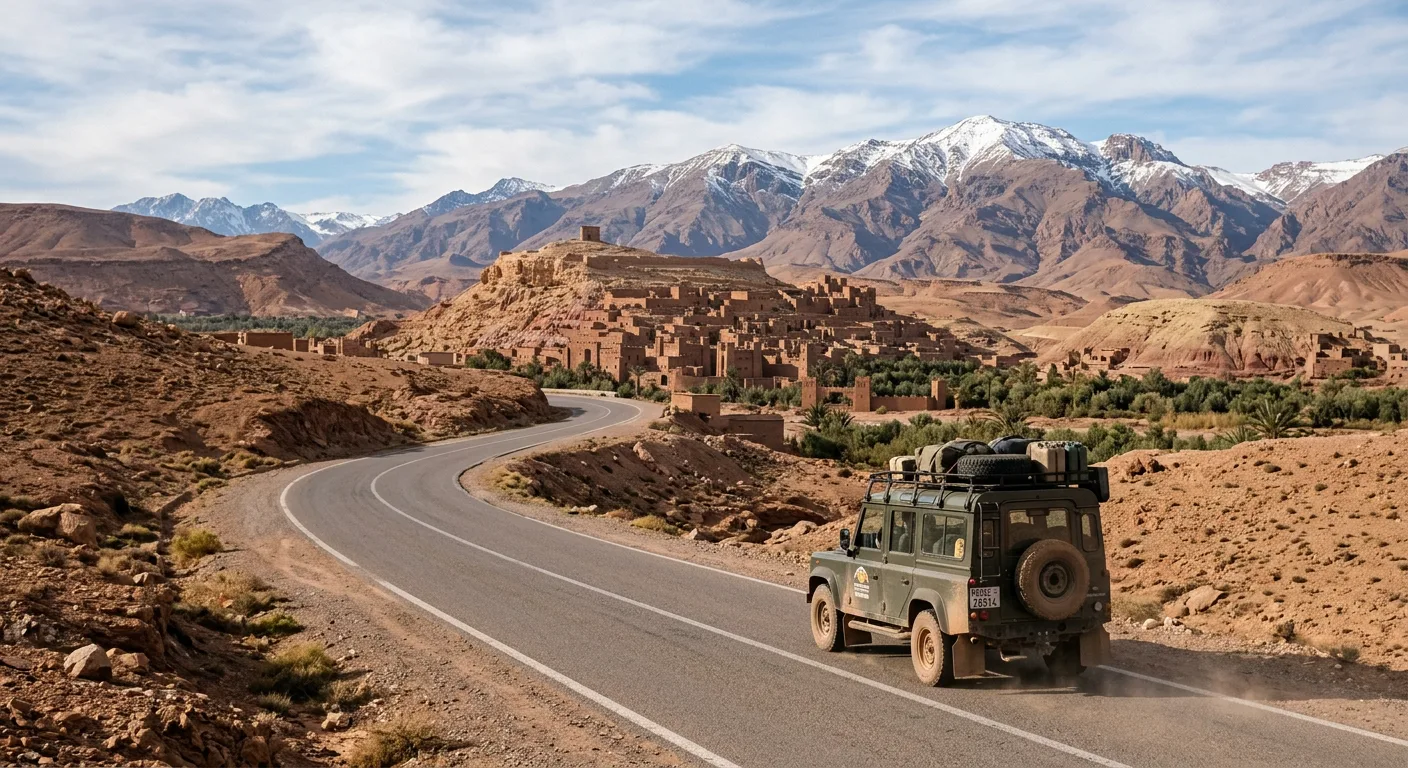
The road to the Sahara is one of the great drives on earth — the landscape shifts from Marrakech palmery to high mountain pass to ochre kasbah to open desert in a single day, and the freedom of pulling over for mint tea at a roadside stop is real. It is also a route that demands your full attention, and the final approach to the dunes is not tarmac at all. Here is what we tell guests who ask, honestly, whether they should rent a car for their desert trip.
What is the road to the desert actually like?
The motorway network — the autoroutes — connecting Casablanca, Rabat, Fes, Marrakech and Tangier is excellent: well-surfaced, toll-maintained, clearly signposted. But the desert run leaves the motorway early. The N9 over the Tizi n'Tichka and the N10 through the Draa Valley are paved national roads, generally well-maintained yet narrow and serpentine: two lorries passing on a switchback often leaves only centimetres to spare. After rain, valley sections flood fast. And the last stretch onto Erg Chebbi or Erg Chigaga is open piste and soft sand — a high-clearance 4x4 with a local driver, never a standard rental, which we never recommend off the tarmac.
How do the desert-road checkpoints work?
Checkpoints (barrages) are a normal feature of the long drive south, not an anomaly — expect several between Marrakech and Merzouga. An officer steps into the road with a baton; you slow and stop. Keep your passport, home licence and rental contract in the glove box, ready to hand over. Officers check speed — they have radar — and occasionally breathalyse. Morocco has a zero-tolerance drink-driving law: the legal limit is 0.0 g/L. Be courteous, patient and clear. If a fine is issued it is paid in dirhams, on the spot; ask for a receipt (un reçu, s'il vous plaît).
Where do you leave the car at the dunes?
You don't drive onto the sand. At the edge of the erg — the village of Merzouga for Erg Chebbi, or M'Hamid for Erg Chigaga — you park at your camp's transfer point and switch to a 4x4 or a camel for the final leg. Camps keep a supervised lot and arrange the handover; you carry an overnight bag and leave the bulk of your luggage with the vehicle. In the gateway cities the historic medinas of Marrakech and Fes are car-free too, so the same logic applies: park outside the walls (gardiens charge 10–20 MAD per day) and walk in, with your riad meeting you at the nearest gate.
What does car hire cost for a desert trip?
A small manual (Dacia Sandero category) runs approximately US$25–40 per day from international agencies (Avis, Hertz, Europcar) at Marrakech or Casablanca airports — but for the dunes you'll want a 4x4, which lands closer to US$60–100 per day. Local agencies advertise lower rates, yet their insurance and breakdown cover are often inadequate for remote routes — read the small print. Full collision damage waiver (CDW) and theft protection are worth paying for. Petrol is roughly US$1.20 per litre (diesel slightly less); stations are well spaced on the main run but thin out east of Ouarzazate.
Why do most desert guests choose a driver-guide?
We are not unbiased — arranging private driver-guides for the desert run is what we do. But the reasons guests give, after self-driving once and then switching, are consistent: the Tizi n'Tichka is more nerve-wracking than expected, the nine-hour days left no energy for the dunes, the language barrier at a checkpoint was uncomfortable, and the holiday became about the road rather than the landscape. A driver-guide removes every one of those frictions. Over a 3–5 day desert loop the cost difference is modest — roughly US$150–220 per day all-in, which across a group of four works out to under US$60 per person per day. You gain a desert expert, a fixer, a translator, and someone who knows exactly which viewpoint to stop at on the pass. See our guide service for details.
Practical rules if you do self-drive
- Never drive after dark on the desert route — livestock, unlit mopeds and drifting sand are serious hazards.
- Download offline maps (Maps.me or Google Maps offline) before you set off — the signal disappears across the mountains and out by the dunes.
- Keep a physical copy of your rental contract, insurance and passport photo page in the car.
- Fill the tank whenever you drop below half — stations become sparse east of Ouarzazate and between Erfoud and Merzouga.
- Never take a standard car onto piste; switch to a 4x4 and a local driver for the final approach to the sand.
- At a checkpoint: engine off, window down, hands visible on the wheel. Slow and calm.
Frequently asked
Is it safe to drive yourself to the Sahara in Morocco?
The tarmac route to Merzouga or Zagora is driveable, but it demands more attention than Western European roads. Rules are loosely enforced in towns, the Tizi n'Tichka switchbacks have few crash barriers, and the final desert approaches turn to unpaved piste. Self-drivers who manage it take the day slowly, fill up early and never drive after dark. The soft sand on the last stretch to Erg Chebbi needs a 4x4 and local knowledge, not a standard rental.
What documents do I need to rent a car for a desert trip?
A valid driving licence from your home country covers most nationalities — no International Driving Permit is required. Add your passport, a credit card in your name, and a minimum age of 21 (sometimes 23 for a 4x4). The rental contract and insurance certificate must ride in the vehicle with you, and you'll want both to hand at the desert-highway checkpoints.
Do police stop tourists on the road to the desert?
Yes, routinely. Checkpoints — an officer stepping into the road with a baton — are a normal feature of the long drive south, not a warning sign. Slow smoothly, wind down the window and have your passport and rental contract ready. Officers usually wave tourists through after a brief check. Stay calm, polite and patient, and speak clearly and slowly.
What is the speed limit on Moroccan roads?
Towns: 40–60 km/h. Open national roads, including most of the desert route: 100 km/h. Motorways (autoroutes): 120 km/h. Speed cameras are common and radar is used at checkpoints. Fines are paid on the spot in cash dirhams. Road signs follow European conventions.
Is it better to hire a driver-guide than self-drive to the Sahara?
For most first-time desert travellers: yes, unequivocally. A private driver-guide removes every friction point — the long mountain crossing, language at checkpoints, navigation where the signal drops, and the piste onto the dunes — and adds local knowledge no app can match. Over a 3–5 day desert loop the cost difference is modest relative to the overall trip, and you arrive rested rather than wrung out.
Can I drive to the dunes at night?
We strongly advise against it. Unlit mopeds, livestock on the road, poorly marked speed bumps, sand drifting across the tarmac and fatigue combine to make night driving the single biggest risk on the desert route. Time your day to reach the camp transfer point before sundown — the last leg to Erg Chebbi or Erg Chigaga is best done in daylight.
Skip the road stress
Let us put a desert driver-guide behind the wheel.
The private driver-guides we work with are English-speaking and know every kilometre of the road to Merzouga and Zagora — including the piste onto the sand. We can pair a driver with a separate local guide at each stop for even deeper immersion.