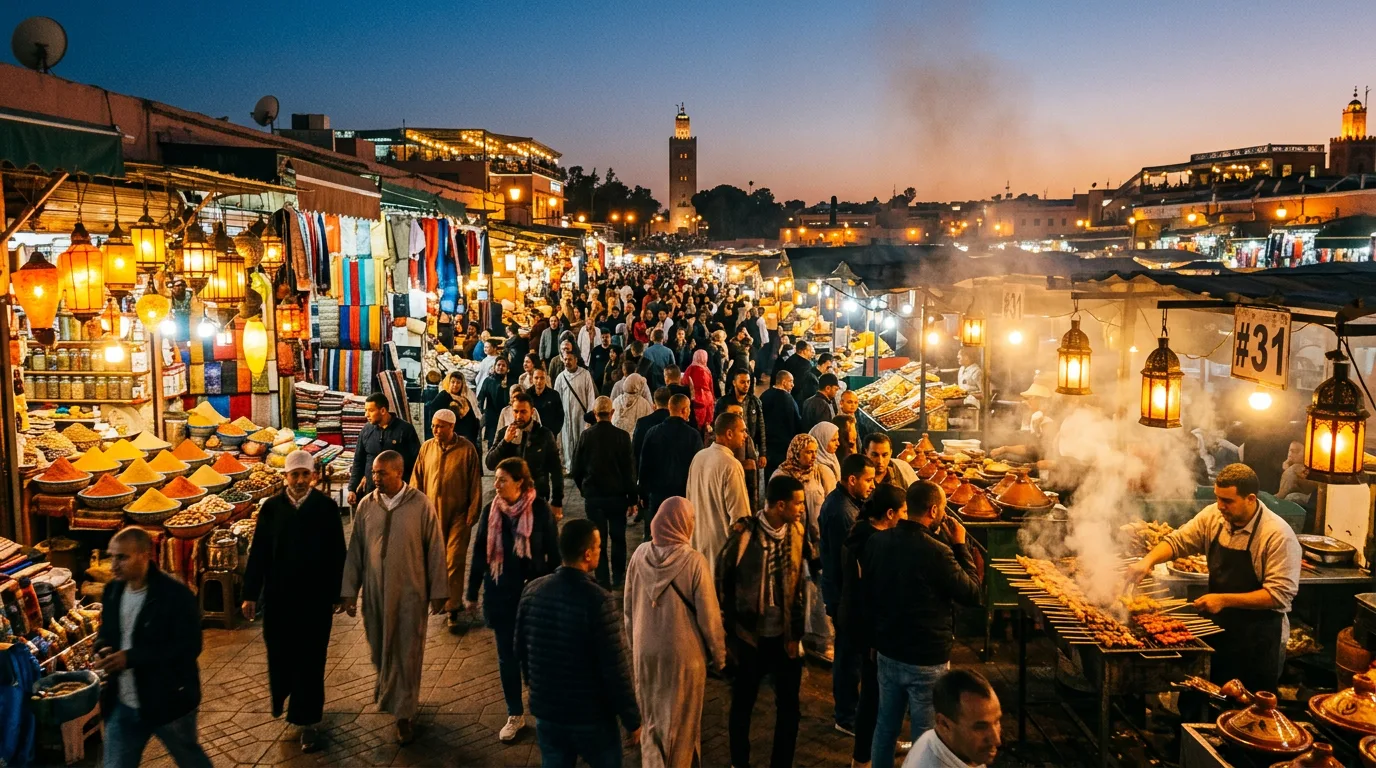
For most of our travellers Marrakech is where the Sahara journey begins — the staging post before the long road south to Erg Chebbi. But the Red City deserves more than a night in transit. Three days lets you move at a human pace through the medina, absorb the garden quarter, dip into the foothills and arrive at the dunes already steeped in Morocco rather than jet-lagged and rushing. Here is how we structure those days for guests heading into the desert.
Day One: The medina on foot
Begin at Djemaa el-Fna before 9 am, when the square belongs entirely to orange juice vendors and locals crossing to work. Walk north into the souks with a licensed guide for your first two hours — the tanneries quarter near Bab Debbagh, the dyers alley, the spice sellers around Rahba Kedima. This is your chance to stock up on a desert scarf and a wide-brimmed hat before the dunes. By late morning, break in a rooftop café overlooking the square.
After lunch, visit the Ben Youssef Madrasa — the finest example of Marinid architecture in the city, restored and genuinely worth the entry fee. Spend the late afternoon wandering the Mouassine neighbourhood without a map. Dinner at a neighbourhood restaurant rather than one of the grand spectacle places on the square; your riad host will have a recommendation that suits your pace.
Return to Djemaa el-Fna after dark. The square transforms into a vast open-air restaurant and theatre. Walk through it rather than sitting — you will understand more by moving.
Day Two: The garden quarter and palaces
Book Majorelle Garden for 8 am — tickets sell out and the light is best early. Yves Saint Laurent and Pierre Bergé rescued the garden from dereliction in 1980; the cobalt-blue Villa Bou Saf Saf that anchors it and the Museum of Moroccan Arts inside justify at least 90 minutes. The adjacent Musée Yves Saint Laurent Marrakech (YSL Museum) is architecturally striking and worth visiting if fashion history interests you — it shares the same entry area. Plan two hours total for the garden quarter.
In the afternoon, cross to the southern medina for the Saadian Tombs and the El Badi Palace. The tombs are a brief visit (20 minutes) but the craftsmanship of the Chamber of Twelve Columns is extraordinary. El Badi is a ruin but the scale of what was once the most lavish palace in the Islamic world is legible in the foundations — storks nest in the walls. Evening: Gueliz, Marrakech's modern district, for a different pace and good contemporary restaurants.
Day Three: Foothills and the first taste of desert
Leave by 8 am in a private vehicle. The destination depends on the group: Ourika Valley (60 km, paved road to 1,800 m, waterfalls at Setti Fatma) suits a relaxed day with a riverside lunch. Imlil (90 km, 1,740 m base altitude) suits those who want to walk — a three-hour loop above the village through Aït Benhaddou hamlet and walnut orchards gives a genuine Berber highland experience without technical climbing.
For travellers who want their first feel of sand before the real Sahara, the Agafay Desert on Marrakech's doorstep delivers a stony, lunar half-day with sunset camel rides and a tented dinner — a gentle preview of the nights you will spend at Erg Chebbi. All return you to the city by evening. When you are ready for the full dunes, browse our Sahara desert tours that run south from here.
Where to stay before the desert
A medina riad — a traditional courtyard house — is the only accommodation we recommend for your nights in Marrakech, the calm bookend to the camp nights ahead. Price range is wide: a well-run mid-range riad costs US$80–140 per night for a double; boutique riads with a pool, resident staff and curated design run US$180–350. Anything inside Bab Doukkala, Mouassine or the Mellah quarter puts every sight no more than a 15-minute walk away. Sahara Desert Adventures helps every traveller with riad selection and slots it neatly around the southbound desert leg.
Pacing and what to skip
The biggest mistake visitors make is attempting too many monuments. Two or three sites per day, interspersed with unstructured time in the souks, is more rewarding than five sites with no room to breathe. Skip the Bahia Palace if time is tight — it is handsome but rarely the memory people carry home. Skip any "free" guide who approaches you in the medina offering orientation; the unofficial guiding economy depends on commissions from carpet and argan oil shops.
On practical logistics: carry small dirham notes for the souks, book Majorelle and YSL Museum online in advance, and avoid the main square restaurants at dinner — the menus exist for tourists and the quality rarely matches the setting. The best meals in Marrakech are in neighbourhood restaurants where the menu is small and changes daily.
Frequently asked
Is three days in Marrakech enough before heading to the desert?
Three full days lets you absorb the Red City's essentials — the medina souks, Djemaa el-Fna, Majorelle Garden and a taste of the foothills — without rushing, then point your compass south toward Erg Chebbi. Most guests treat Marrakech as the launch pad: three days here, then a multi-day overland run to the Sahara dunes. If the city itself is the goal, you may want a fourth night.
What is the best area to stay in Marrakech as a desert gateway?
For a first visit, a riad inside the medina walls puts you within walking distance of everything and a short transfer from the southbound road. The northern medina near Mouassine or the Bab Doukkala neighbourhood balances atmosphere, relative quiet and souk access. Hivernage and Gueliz suit travellers who want a modern hotel with a pool before a long desert drive.
When is the best time to visit Marrakech and the Sahara together?
October through early December and mid-February through April give mild days (20–26 °C) in the city and bearable temperatures on the dunes, with cool desert nights ideal for stargazing. July and August push past 38 °C in Marrakech and far hotter in the Sahara, making midday camel treks punishing. December and January are cool and occasionally rainy in the city but the desert nights turn genuinely cold.
Do I need a guide for the medina?
For your first morning in the souks, a licensed guide is well worth it — the medina's labyrinth of derbs is genuinely disorienting, and a good guide will show you craft quarters and hidden fondouks you would never find alone. By your second day you will have a feel for the main arteries and can wander more freely. Sahara Desert Adventures can arrange a city guide for your first morning before the desert leg begins.
How do I get from Marrakech Menara Airport to my riad?
Official grands taxis and the Airport Express (bus line 19) are the budget options. Sahara Desert Adventures arranges private chauffeured transfers for all guests — the same vehicle and driver-guide that will later carry you south to the dunes meets you at arrivals, handles luggage and drops you as close to your riad entrance as the medina's narrow streets allow.
Can I combine a Marrakech stay with a Sahara desert trip?
Yes — this is our core route. From Marrakech the classic overland run crosses the Tizi n'Tichka pass to Aït Ben Haddou, then continues to Merzouga and the Erg Chebbi dunes for camel trekking and a night under the stars at a desert camp. Allow three days and two nights minimum for a comfortable round trip; longer itineraries add Erg Chigaga or Zagora. We tailor the pace to your group.
Ready to go deeper?
We pair the Marrakech most visitors miss with nights under the Sahara stars.
Every Sahara Desert Adventures traveller gets a private driver, a local guide on request and WhatsApp support — from the medina to the Erg Chebbi camp. No group buses, no commission shops, no script.
Request an itinerary