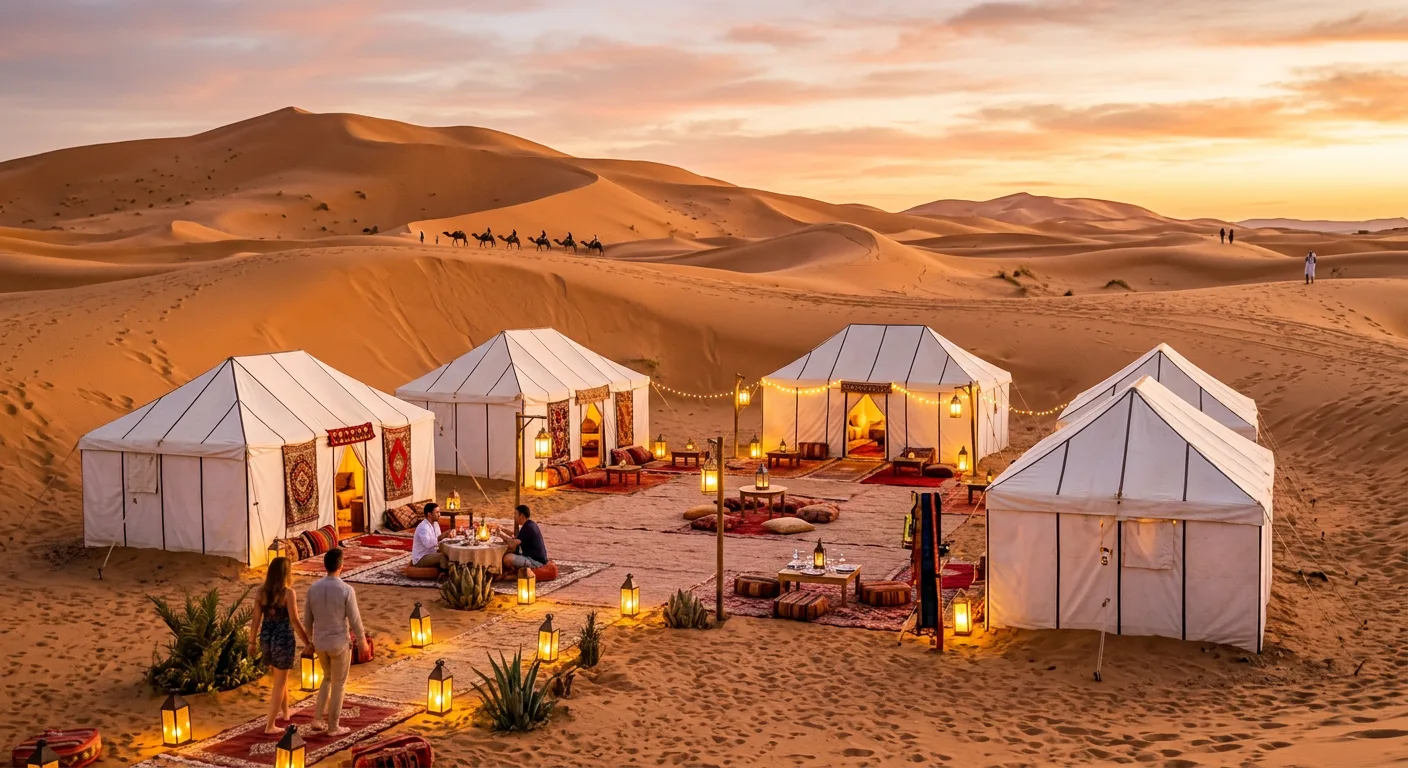
This is the question every desert traveller starts with: which dunes? Erg Chebbi at Merzouga for towering, accessible grandeur; Erg Chigaga near M'Hamid for true remoteness; or Zagora for a quick taste when time is short. We break down the three, what the camps are really like, when to go and how to get there.
In this guide
Merzouga, Chigaga or Zagora — picking your dunes
All three are genuinely different trips, not interchangeable. Erg Chebbi at Merzouga is the dune sea you've seen in photographs — sculpted orange ridges rising to roughly 150 metres, about 8–9 hours from Marrakech, and home to the deepest choice of luxury camps. It's the easy, dramatic, first-timer's Sahara. Erg Chigaga, beyond M'Hamid el Ghizlane, is the wild one: around 11–12 hours from Marrakech with the last 50 km on open piste, far fewer camps, no road along the dunes, and ridges you may have entirely to yourself.
Zagora is the shortcut — about 6 hours from Marrakech and doable as a fast overnight, but its dunes (Tinfou, and Erg Chegaga further south) are modest beside Erg Chebbi, so travellers chasing the postcard sometimes feel short-changed. Our rule of thumb: Zagora when the clock rules, Merzouga for the classic spectacle, Erg Chigaga when solitude matters more than the drive.
Standard vs luxury camps — what you actually get
The difference between a basic and a luxury desert camp is bigger than most first-timers expect, so it pays to know what you're booking. Standard camps run shared or simple tents with mats, blankets and shared washrooms, a communal dinner and a campfire — perfectly atmospheric, but basic, and livelier when a group arrives. They're the value choice and the backbone of most affordable tours.
Luxury camps — a relatively small number of genuinely good ones across Merzouga and Chigaga — give you a fixed ensuite tent or geo-dome with a real bed, hot shower, electricity and heating or cooling. Expect a proper multi-course dinner under the stars, private fire pits and, at the best of them, a sunrise camel ride before any day-trippers appear. Some Erg Chigaga camps are sited so no other camp is even in view — a level of isolation that's hard to find at busier Erg Chebbi.
- Signs of a good luxury camp: private ensuite bathrooms, permanent fixed tents or domes (not flimsy fabric rooms), a modest tent count, and quiet generator-off hours.
- Typical luxury camp range: US$150–350 per person per night, all meals and treks included.
- Steer clear of camps marketing 'desert parties' or built around big bus groups if you want quiet.
- At Erg Chebbi, camps toward the western edge of the dune field tend to have cleaner sand and fewer neighbours.
When to go to the dunes
October to April is the season. Through these months daytime temperatures sit comfortably around 18–30°C, the low sun sculpts the dunes morning and evening, and the camps are at full swing. Nights from November to February turn genuinely cold — single digits Celsius — so a real warm layer is non-negotiable; good camps stock extra blankets and many lend fleece jackets.
Avoid high summer for the deep south. July and August push Merzouga to 45–50°C, the camel trek shrinks to a brief dawn or dusk formality, and many quality camps close or scale back. If summer is your only option, restrict desert activity to the first and last hour of daylight and keep expectations modest.
Getting to the dunes
To Merzouga: the classic route from Marrakech climbs the High Atlas over the Tizi n'Tichka pass (2,260 m), then runs through Ouarzazate and the Dadès and Todra gorges — roughly 550 km, best broken over two days with a kasbah-road overnight. Buses (CTM, Supratours) reach Ouarzazate and beyond, but a private vehicle makes the stops worthwhile. From Fes it's a single long day of about 6–7 hours via Ifrane and Midelt.
To Erg Chigaga: M'Hamid el Ghizlane is the last tarmac, and from there a 4x4 covers the final stretch of piste to the dunes (around 50 km), arranged by your camp. M'Hamid itself sits roughly 9–10 hours from Marrakech via Ouarzazate and the palm-lined Draa Valley — a journey deep into nomad country that's a highlight in its own right.
Frequently asked
How many days do you need in the Sahara?
One night is the minimum that feels worthwhile — arrive mid-afternoon for a camel trek and sunset, sleep out under the stars, catch sunrise and head back. Two nights is far better: a longer walk into the dunes, time to sit in the silence after the day groups leave, and no clock-watching. For remote Erg Chigaga, two nights is strongly advised given the long transfer.
Is Merzouga or Erg Chigaga better?
Merzouga (Erg Chebbi) suits first-timers — bigger, easier-to-reach dunes and the widest choice of camps. Erg Chigaga suits those who've seen Merzouga or simply want wilderness: fewer people, a wilder feel and tougher, more rewarding logistics.
Is a camel trek worth it?
For most people, yes. A 20–45-minute ride over the dunes to camp is the real thing, not a gimmick — the silence, the scale and the slow sway across the sand are hard to find any other way. Longer two- to three-hour treks suit anyone wanting a more physical desert day.
Can you see the Milky Way in the Moroccan Sahara?
On a clear, moonless night away from the generator lights — spectacularly. Erg Chigaga edges it for darkness over Merzouga's busier dune edge. Skies are clearest from late autumn to early spring, and timing your trip near a new moon makes all the difference.
What should you pack for a camp night?
Warm layers in any season (October–March nights are cold), a headlamp for moving around camp after dark, and slip-on shoes or sandals that shrug off sand far better than laced boots. Luxury camps supply towels, blankets and toiletries; bring your own for standard camps.
Is the Moroccan Sahara safe to visit?
Yes. The tourist desert regions around Merzouga, Erg Chigaga and Zagora are politically stable and heavily visited, and bear no resemblance to the instability of the wider Sahel far to the south and east. Use a registered operator and take normal travel precautions.
Planning a trip?
Let our desert team handle the details.
Tell us your dates and style and we'll send a written itinerary and a transparent quote. We confirm by email within 24 hours.
Request an itineraryKeep reading
Planning
The Best Time to Visit Morocco
If the desert is the heart of your trip, plan around the dunes first. October to April is the prime Sahara window — comfortable days in Merzouga and Erg Chigaga, brilliant stargazing and cold but magical camp nights. Spring and autumn are the all-round sweet spots for combining the dunes with the cities and the Atlas.
Itineraries
Morocco Itinerary: 10 Days
Ten days is the sweet spot for a desert-led trip — long enough to reach the dunes unhurried, spend two nights deep in the Sahara, and still see the gorges, kasbahs and one imperial city, with the coast as an optional finish.