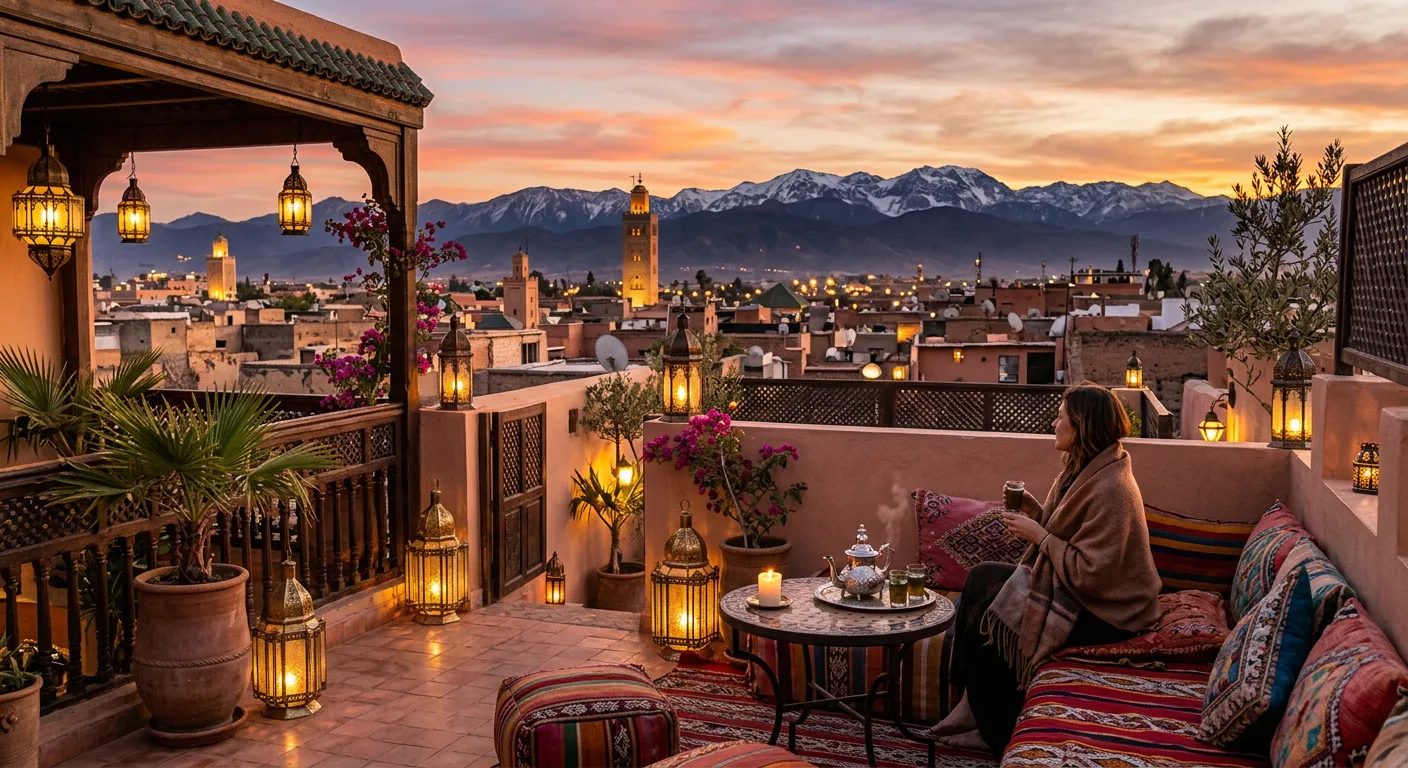
For a honeymoon, the Sahara is the centrepiece: a private candlelit dinner served on the dunes, a sky thick with stars and no one else for miles, a sunrise camel ride for two. Wrap a luxury desert camp into a Marrakech riad-and-hammam trip and you have one of the most romantic journeys on earth.
In this guide
Why the desert makes the honeymoon
Couples come back from Morocco talking about one thing above all: the night in the dunes. A luxury Sahara camp delivers a level of intimacy hotels rarely match — your own ensuite tent set apart from the rest, a private fire, dinner under a canopy of stars with the whole desert silent around you, and a sunrise climb up the nearest crest before anyone else stirs. It is the romantic high point of the trip, and everything else frames it.
Build it into a private, driver-led journey so you keep your own pace — linger over breakfast, stop for that Atlas-pass photo, arrive at camp in time for the sunset. Tell the camp it's a honeymoon and the better ones add rose petals, a private dune-top dinner or a bottle of Moroccan wine without you having to ask.
Framing the desert: romantic bases on the way
Marrakech, your likely start and finish, has the greatest concentration of genuinely luxurious riads — private plunge-pool suites, terraces with Atlas views, in-house hammams and chefs who cook for you alone. The quieter Mouassine and Bab Doukkala quarters are intimate yet walkable to everything, a gentle bookend to the desert nights.
On the kasbah road in, a restored kasbah guesthouse near Aït Ben Haddou or Skoura's palmery makes a romantic overnight that breaks the drive. And if you want to decompress after the Sahara, finish on the Atlantic at Essaouira — white ramparts, fresh seafood and salt air — before the flight home.
Choosing a luxury desert camp for two
The camp choice makes or breaks a desert honeymoon, so weigh comfort against solitude. Erg Chebbi at Merzouga has the widest range of luxury camps and the easiest access; the remote Erg Chigaga, reached by 4x4 across the piste from M'Hamid, trades convenience for a near-private wilderness where the nearest neighbour may be out of sight entirely. For either, book a permanent ensuite tent or private dome — the gap between a basic and a luxury camp is enormous on a honeymoon.
- Erg Chebbi (Merzouga): the most accessible dunes; the widest choice of luxury camps and a smoother road in.
- Erg Chigaga (M'Hamid): wilder, emptier and more remote — a 4x4 piste transfer that's an adventure in itself, ideal for couples who want isolation.
- Either way: book a private ensuite tent or dome, request a dune-top dinner, and ask about a private sunrise camel ride before the day-trippers arrive.
A suggested 7–10 day romantic route
For 7 days: two nights in Marrakech (private riad, hammam, medina dinner); one night over the Atlas at Aït Ben Haddou; two nights at a luxury desert camp; one night back in Marrakech before departure. For 10 days: add two nights in Essaouira at the end — the Atlantic wind, the white ramparts and the seafood are a perfect decompression after the desert.
- Marrakech (2–3 nights): luxury riad with plunge pool; private medina tour; hammam for two; rooftop dinner.
- High Atlas crossing (1 night): Aït Ben Haddou and dinner at a kasbah guesthouse.
- Sahara (2 nights): arrive by afternoon for dune sunset; private camp dinner; sunrise camel ride.
- Ouarzazate or Drâa Valley (1 night): kasbah architecture and palm groves on the return.
- Essaouira (1–2 nights, optional): blue-white ramparts, fresh seafood, a quieter pace.
Frequently asked
When is the best time for a desert honeymoon?
Spring (March–May) and autumn (September–November) are ideal: warm desert days, comfortable camp nights and the dunes at their most photogenic. Winter brings the clearest stargazing but cold nights, while inland summer heat (July–August) is best avoided for a desert trip.
What makes a desert camp right for a honeymoon?
Look for a luxury camp with a private ensuite tent set apart from the others, the option of a dune-top dinner for two, and a private sunrise camel ride. At Erg Chebbi you get easier access and choice; at Erg Chigaga you get near-total solitude. Tell the camp it's a honeymoon and they'll add romantic touches.
Is a desert honeymoon expensive?
A private Marrakech–desert honeymoon with luxury riads, a private driver and a luxury camp realistically runs from around US$300–600 per couple per day in-country. A 7-day trip for two lands roughly US$2,500–5,000 excluding international flights, depending on camp and riad standard.
Do desert camps offer honeymoon touches?
The better luxury camps will, when told in advance — rose petals, a private dune-top dinner, a bottle of Moroccan wine, a sunrise ride for two. There are rarely formal packages; it's more personal than that, so let the camp and your riad know the occasion before you arrive.
Is Morocco suitable for LGBTQ+ honeymooners?
Same-sex relationships are criminalised under Moroccan law, and public displays of affection between same-sex couples can attract unwanted attention or legal risk. Morocco is not currently a recommended destination for LGBTQ+ couples seeking an open, celebratory honeymoon — the experience in the medinas and smaller towns would require significant discretion.
Planning a trip?
Let our desert team handle the details.
Tell us your dates and style and we'll send a written itinerary and a transparent quote. We confirm by email within 24 hours.
Request an itineraryKeep reading
Planning
The Best Time to Visit Morocco
If the desert is the heart of your trip, plan around the dunes first. October to April is the prime Sahara window — comfortable days in Merzouga and Erg Chigaga, brilliant stargazing and cold but magical camp nights. Spring and autumn are the all-round sweet spots for combining the dunes with the cities and the Atlas.
Planning
Morocco Travel Costs & Budget
A Sahara desert tour fits almost any budget. A shared standard tour with a basic camp can be remarkably cheap; a private 4x4 trip with a luxury camp at Erg Chigaga and a driver-guide sits firmly in premium territory. Knowing where the money goes helps you spend it on the parts that matter.