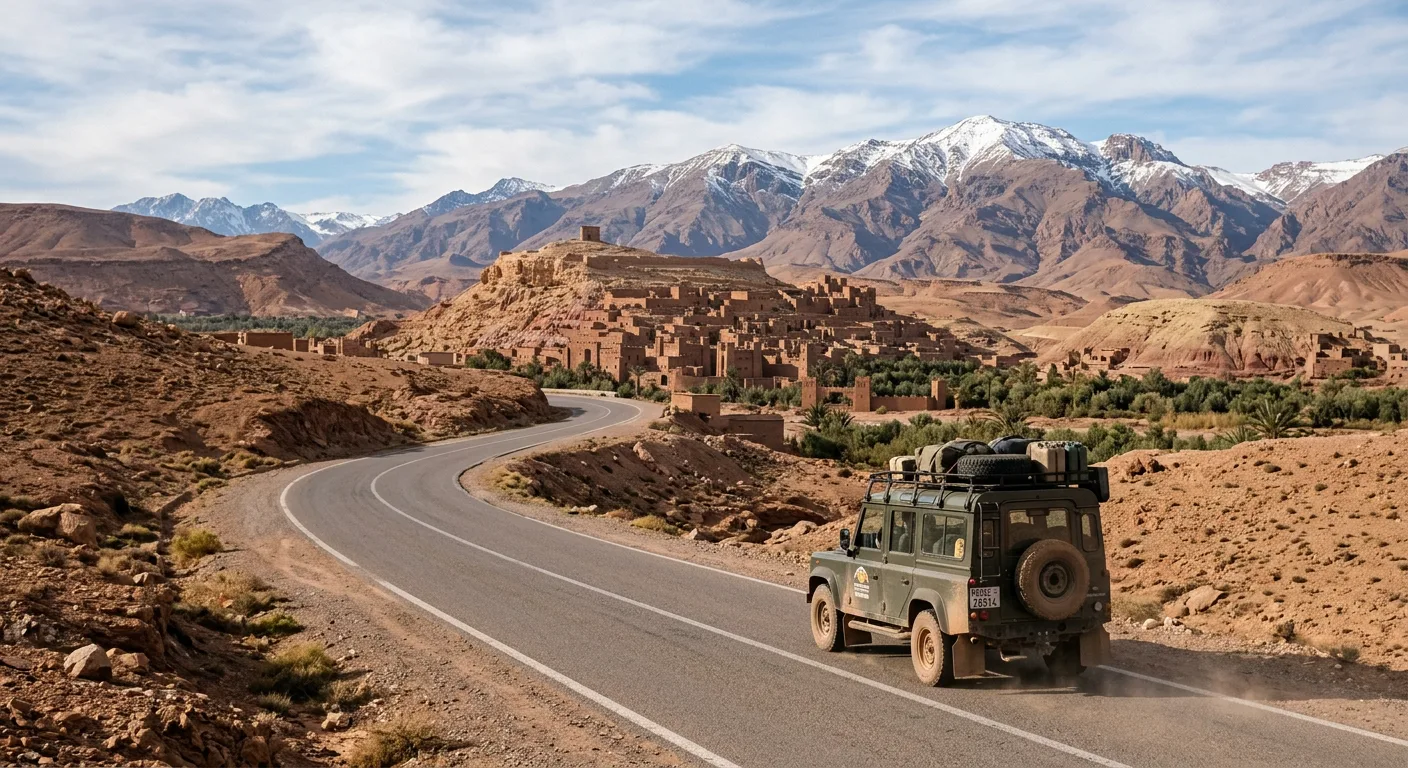
Trains cover Morocco's northern cities well, but the desert lives beyond the rail map. To reach Merzouga, Zagora or Erg Chigaga you'll travel by private 4x4 or driver-guide, by long-distance bus, or on an organised tour — and the journey through the Atlas and the Draa Valley is a highlight in itself.
In this guide
How the desert connects
The ONCF rail network links Tangier, Rabat, Casablanca, Fes, Meknes and Marrakech, including the Al Boraq high-speed line (Tangier–Casablanca in about two hours). It's the easy way to reach your starting point. But no train runs to the dunes: from Marrakech or Fes the desert is reached overland, crossing the High Atlas, the kasbah road and the gorges before the sand begins. CTM and Supratours buses reach Ouarzazate, Zagora and Merzouga, while most visitors join a tour or hire a private vehicle.
Why most desert travellers use a private 4x4 and driver
For the run to the Sahara, a private driver-guide is the comfortable choice: door-to-door from your riad, all your luggage, your own pace, and the freedom to stop at Aït Ben Haddou, a Skoura kasbah, the Todra gorge or a roadside argan co-op. The Tizi n'Tichka pass and the desert pistes out to Erg Chigaga are demanding to self-drive, and a 4x4 with a local driver doubles as guide, translator and the person who knows which track stays open after rain.
Taxis, buses and the last stretch to the dunes
Within cities, small 'petit taxis' handle short hops — agree the fare or insist on the meter — and 'grand taxis' run fixed intercity routes. For airport arrivals, a pre-booked transfer with a flight-tracked, name-board pickup spares you the arrivals-hall haggling. The final approach to the camps is often by camel or 4x4 across the sand once the road ends, arranged through your tour or camp.
Frequently asked
How do you get to the Sahara from Marrakech?
There's no train to the dunes. From Marrakech you travel overland — most people by private 4x4 or driver-guide, or on an organised tour, crossing the Atlas to Ouarzazate and on to Merzouga or Zagora. Buses run too, but a private vehicle lets you stop at the kasbahs and gorges along the way.
Should I rent a car for a desert trip?
Self-driving is fine on the motorways but demanding on the Atlas passes and impossible on the soft desert pistes out to Erg Chigaga. Most visitors prefer a private driver who navigates, translates, guides and handles the rough tracks.
How do I get from the airport to my desert tour?
Pre-book a private transfer with a fixed price and name-board pickup at Marrakech or Fes, then meet your desert vehicle or join your tour departure the next morning. Many operators collect you straight from your riad.
Planning a trip?
Let our desert team handle the details.
Tell us your dates and style and we'll send a written itinerary and a transparent quote. We confirm by email within 24 hours.
Request an itineraryKeep reading
Planning
Morocco Travel Costs & Budget
A Sahara desert tour fits almost any budget. A shared standard tour with a basic camp can be remarkably cheap; a private 4x4 trip with a luxury camp at Erg Chigaga and a driver-guide sits firmly in premium territory. Knowing where the money goes helps you spend it on the parts that matter.
Planning
The Best Time to Visit Morocco
If the desert is the heart of your trip, plan around the dunes first. October to April is the prime Sahara window — comfortable days in Merzouga and Erg Chigaga, brilliant stargazing and cold but magical camp nights. Spring and autumn are the all-round sweet spots for combining the dunes with the cities and the Atlas.